Handling of branches during the shaping of Chinese ash bonsai
Pruning is one of the most commonly used methods in tree bonsai shaping, and how to prune branches to better meet aesthetic standards has always been worth exploring for bonsai creators. However, for different creators, their creative personality, thinking, temperament, cultivation, and preferences are often not the same, so their pursuit of and orientation toward beauty often also differs. Therefore, different creators can hardly organically unify aesthetic effects and value orientations.
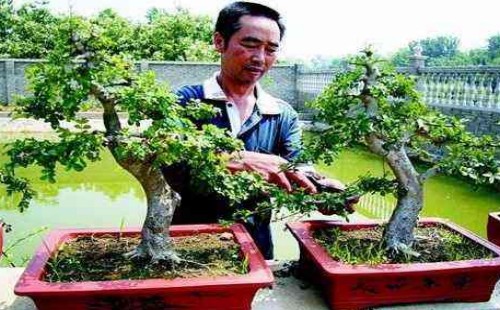
As a brand-new artistic creation in the new era, Chinese ash bonsai has formed its own set of rules during the creative process because it is relatively independent in creative techniques and artistic expression forms. This is especially true in the shaping process, where the reduction and retention of branches involved in the bonsai framework are even more distinctive. Whether in terms of proportion, angle, outline, or aesthetics, there are relatively independent propositions in shaping and pruning.
I. Retaining branches and setting supports
For Chinese ash trees, especially the cultivation of stump bonsai, attention must be paid during the process of retaining branches and setting supports to the removal of redundant branches. If it is impossible to determine how to retain or remove branches because there are too many branches and buds on the stump bonsai, or if there are biases in the conception and creative ideas for the bonsai, incorrect pruning is inevitably likely to occur. Although adjustments can be made later, this often leads to too long a time for growing branches and shaping. Setting supports is the basic condition, and during this period it is necessary to integrate the creator's ideas according to the characteristics of the stump bonsai, such as straight, slanting, curved, lying, suspended, and waterside. During the process of retaining branches and setting supports, redundant and complicated branches and buds should be promptly pruned, which can save nutrients, strengthen the retained branches, and help accelerate the pace of pruning and shaping.
II. Balancing proportions
During the period of growing and maintaining branch supports, various factors may cause branches to grow excessively. At this time, how to prune, to what extent to prune, and the balance of branch thickness and length often run through the entire bonsai shaping process and affect the overall framework of the bonsai. Whether the proportions between branches and trunk, between branch supports, within branch supports, and among secondary vein tiers are coordinated all need to be clarified before cutting, so that one has a clear idea and can respond calmly. After clarifying the veins, cut according to scientific rules, and only then can it be just right. Therefore, in order to balance branch proportions, pruning work is very particular.
III. Angle orientation
During the pruning process, regarding the angles of bonsai branches and buds, the direction of branch forks, the phenomenon of unevenness among them, and the issues of branch supports extending and retracting and turning up, down, left, and right, if the pruning angle is improper, the shaping effect is often prone to appearing too stiff and mechanical, and may even give people a forced feeling. Although sometimes methods such as wiring can be used to remedy it, the natural beauty will be lost. Therefore, before cutting, we must choose the angle well and consider comprehensively, without attending to one thing and losing another. That is, the direction of the branches, their spatial state, and their relationship with other branch supports must be clear, and they must be conceived in advance to reduce misjudgments and wrong judgments. Therefore, after choosing the angle well, carry out precise pruning.
IV. Outline control
The outline mentioned here by the editor mainly refers to the outer outline of the bonsai framework, which is the overall form of the bonsai. In the process of determining the outline, the length of a small number of branches should be subordinate to and serve the whole, integrating points and lines into the whole. The principle is: observe the whole, prune locally, and adjust the entire area. After a series of pruning and improvement treatments, the Chinese ash bonsai tree will also gradually become fuller and more mature, and this stage can also be regarded as the finishing work in the bonsai shaping process. The focus of the treatment is to coordinate the overall relationship between the opening and closing of branch support lengths and the outline.