How to prune a Chinese ash bonsai? A detailed guide to the correct pruning method
A beautiful bonsai work inevitably has a distinctive shape, and creating that shape is often inseparable from pruning, and pruning techniques play a very important role in the bonsai shaping process. Because whether the branches are pruned well or not will directly affect the beauty of the bonsai's shape and its ornamental effect. The same is true for the Chinese ash bonsai; it can be said that pruning is the most commonly used and most important method in shaping the Chinese ash bonsai. So, how do you prune a Chinese ash bonsai?
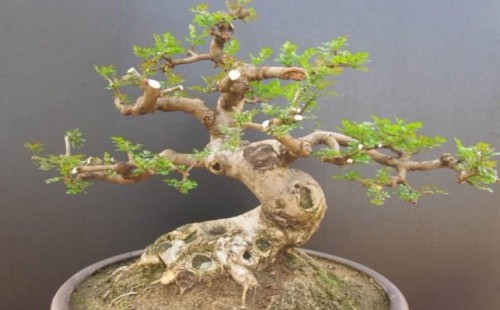
Although Chinese ash is a deciduous tree, it has strong adaptability to the environment, grows quickly, and is highly malleable and tolerant of pruning. However, pruning cannot be done blindly, because a Chinese ash bonsai that has not been pruned properly cannot really be considered a bonsai work at all. It is clear that its shaping effect and ornamental value will either be greatly reduced or completely lost, so we should take the pruning work for Chinese ash bonsai seriously.
1. Balanced pruning
Balanced pruning means carrying out all-round pruning treatment on the entire bonsai, and this pruning technique is usually carried out when the Chinese ash bonsai tree has basically taken shape or has already taken shape and is about to be used for exhibition. By comprehensively pruning the entire bonsai and repeatedly considering which branches to keep and which to remove, the branches of the bonsai tree can become fuller, the shape more mature, the plant form more beautiful, and the ornamental value higher.
2. Unbalanced pruning
Unbalanced pruning is actually a treatment method for adjusting only part of the branches of the bonsai tree, that is, non-comprehensive pruning. It is mainly detailed treatment carried out according to the physiological characteristics of Chinese ash, branch growth, and shaping effect, to avoid sick or incomplete branches, and it includes two methods: thinning and branch control.
1) Thinning
Thinning is usually carried out when the Chinese ash stump landscape has survived and branches are being retained and supports are being set. It mainly involves cutting off all redundant branches. While improving the bonsai's air circulation and light-receiving area, it can also allow nutrients to be transported in a more concentrated way, letting the retained branches grow more robustly, thereby shortening the time for branch and trunk development.
2) Branch control
In the early stages of branch development and shaping, due to the influence of many factors such as light and apical dominance, the overall branches of the original bonsai tree often cannot grow in sync, and the growth rates among branches also vary. In order to promote the growth of weak branches as quickly as possible, we should tip-prune most of the branches that have grown to the proper proportions so as to achieve the purpose of branch control. This is done to make all branches achieve an overall coordinated and consistent effect. By balancing branch growth, a small number of immature branches can develop quickly while avoiding any impact on the beauty of the shape.
3. Pruning with leaves
Pruning with leaves mainly means that when shortening branch nodes, leaves must be kept, especially when preparing to retain one node's bud, leaves should be kept. But if there are no leaves on the branch, the node should be extended downward to a place with leaves before cutting, so as to achieve the effect of forcing buds. Then, after the retained bud area has normally sprouted, prune it back into place again. This is mainly caused by the physiological characteristics of Chinese ash and the guiding effect of tree sap. Therefore, for pruning a Chinese ash bonsai, it is generally necessary to carry it out with leaves; otherwise, the cut may shrink, and it may even cause the branch to die.
4. Reserved pruning
Because different tree species have different wound self-healing abilities, we also need to prepare for all eventualities during pruning, usually making reservations with prevention as the priority. If it cannot be done properly in one go, it can be done in multiple sessions, each time keeping 1-2 extra backup buds. After the retained buds have sent out fine branches that become strong, or when the reserved area naturally withers, then cut them off. However, pruning in this situation will inevitably encounter thick branches, and after cutting them off, relatively large wounds will remain and are prone to shrinkage, so some can be appropriately reserved. By contrast, the wounds left by thin branches usually do not shrink as obviously, or are much smaller, so we only need to leave them shorter.