Bonsai pruning techniques for Chinese fringe tree (Chionanthus retusus): easily maintain a beautiful shape
The Chinese fringe tree bonsai is a work created through deliberate processing by people. Although it undergoes long-term pruning to maintain a perfect shape, it has not lost its vitality and often continues to grow. Conversely, if pruning is not carried out in time during normal care, as new branches keep sprouting and growing, some branches will inevitably affect the original beautiful plant shape, thereby reducing or eliminating the ornamental value of the bonsai work. It can be seen that scientific pruning is very important for the Chinese fringe tree bonsai to maintain a beautiful ornamental effect. So, how should the Chinese fringe tree bonsai be pruned to maintain a beautiful shape?
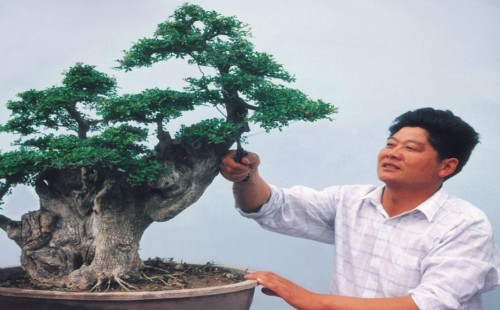
Pruning work is very important for the Chinese fringe tree bonsai to maintain a beautiful shape, and pruning work must be done in time. The main principle adopted is "shorten long branches, thin out dense branches", and through pruning, the branches are kept in appropriate proportions so that the bonsai always maintains an excellent ornamental effect. As for the daily pruning work after the shape has been formed, we usually call it "shape-maintenance pruning", just like people getting a haircut in daily life, in order to keep the hairstyle in a perfect state at all times.
1. Pinching
Pinching is a method often used in the process of bonsai care and management. For the Chinese fringe tree bonsai, it is mainly to control the bonsai branches from growing too long and too dense, and to promote balanced development and even extension of side branches. Pinching mainly involves pinching off the tender tips at the ends of the bonsai branches, thereby dispersing the growth points that have obvious dominance, so that the side branches can grow in a balanced way. If we do not normally need to fill in gaps in local positions, we need to pinch in time. Another purpose of pinching is precisely to control growth and keep the original plant shape stable.
2. Bud removal
Through normal pinching, the growth points on the bonsai branches are dispersed to various places, but at this time another problem is also caused, namely that a large number of adventitious buds will sprout on the branches and trunk of the Chinese fringe tree bonsai. If these adventitious buds are not removed, many forked branches will grow out from the branches and trunk, causing the branches and trunk to fork, which will inevitably damage the original shape effect and also consume a large amount of nutrients and water, thereby weakening the tree's vigor. Therefore, once the Chinese fringe tree sprouts a large number of adventitious buds, we should remove them in time. This is very important for maintaining the original beautiful plant shape of the bonsai.
3. Leaf removal
Leaf removal is a method that is very necessary in the daily care and management of the Chinese fringe tree bonsai. Through scientific leaf removal, the bonsai tree can be prompted to sprout new leaves multiple times each year, thereby keeping the bonsai in a fresh green state as a whole, improving the bonsai's vitality and ornamental value, and bringing viewers a pleasing enjoyment. Although it is called leaf removal, it is generally still recommended to use special scissors to cut off the leaves. If the leaves are pulled off by hand, it is relatively easy to damage the bark.
4. Branch pruning
Tree bonsai tends to grow many new branches during growth, especially after pinching, when it is relatively easy for more side branches and fine branches to sprout. In order to continue maintaining a beautiful plant shape, it is often necessary to frequently use branch pruning to cut off excess branches. However, the branch pruning process also needs to refer to the shape of the bonsai tree, and the choice of what to keep or remove is decided according to the tree shape. For example, for a cloud-layer shape effect, when pruning, the branches should be cut into a flat form. But at the same time, the plant may also grow branches in forms such as dry branches, parallel branches, leggy branches, crossing branches, and overly dense branches, and we also need to cut these off as well.
5. Root pruning
For bonsai trees, root pruning is generally carried out during repotting. It mainly involves cutting off overly dense roots, old and weak fine roots, and overly long roots, thereby stimulating the tree to sprout new roots, improving the root system's ability to absorb, and thus ensuring that the tree can always maintain vigorous growth. However, root pruning also needs to be adapted to the individual tree. For Chinese fringe tree bonsai with underdeveloped roots, it is not necessary to prune a large number of roots during repotting; while for bonsai with densely distributed and well-developed root systems, it is often necessary to strengthen root pruning during repotting to promote new roots.