Detailed Explanation of the Styling Methods and Techniques for Slanting-Trunk Bonsai
There are many styles of tree bonsai, and the slanting-trunk style is one of the more common styling forms. Slanting-trunk bonsai has a tilted straight trunk, with roots gripping the ground firmly, and the center of gravity leaning to one side, making it look very steep and perilous. Although the straight trunk of a slanting-trunk bonsai is in a tilted state, its roots and base grip the ground firmly in the direction opposite to the straight trunk, possessing the momentum of “four taels deflecting a thousand jin,” which is the typical characteristic of slanting-trunk bonsai.
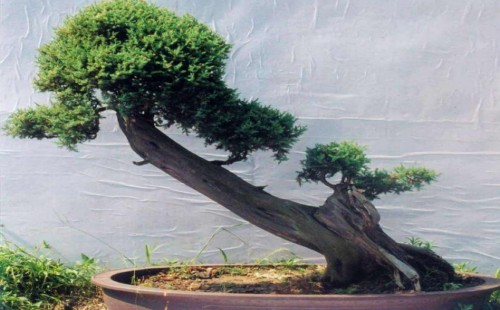
Slanting-trunk bonsai has a unique style, is full of spirit and charm, and possesses extraordinary artistic appeal, but the peculiar shapes are generally not innate; rather, they are completed through later processing and production by people. Whether the ornamental and artistic value of a slanting-trunk bonsai is high or not directly reflects the technical level of the creator. Today, the editor will share with everyone the styling of slanting-trunk bonsai, hoping that everyone can gain a deeper understanding of this styling form.
I. Straight Slanting-Trunk Styling
The most typical characteristic of the straight slanting-trunk styling effect is that the main part of the trunk is straight and in a tilted state, while the top part of the trunk can bend and twist. Viewed as a whole, the lower part of the entire trunk has a rather masculine momentum, while the top highlights a feminine quality, and the root of the tree stump grips the ground strongly in the direction opposite to the trunk. The floating branch that is sent out can play a role in balancing the center of gravity, striving for stability within danger. Obviously, for a tree bonsai with a straight slanting-trunk styling effect, although the main trunk trend and the top branch develop in the same direction, they form an acute angle with each other and extend upward, bringing a sense of soaring movement while also being full of spirit and charm.
If the floating branch is replaced with a trailing branch, making it form a unified whole with the main trunk and the top trunk, the center of gravity of the bonsai deviates from the root head, but the strongly gripping trailing root stabilizes the steep posture, like a ship anchored in a storm, letting the wind blow and the waves beat, yet still able to remain standing firm. The trunk body of the bonsai tree stands tilted, and with a semi-floating, semi-cascading branch arranged in the same direction, it has a cliff artistic conception of danger within danger, full of the interest of a water-reflection scene.
II. Hard-Angle Bent Slanting-Trunk Styling
For this type of bonsai tree, the trunk body is relatively straight and stiff, but very strong and powerful, with an imposing posture. However, for this slanting-trunk styling effect, it is often necessary to develop according to the material, combining hardness and softness, and seeking stability within danger to reflect its individuality and characteristics. There are mainly two forms: one is that the trunk body stands upward in a hard-angle bent slant, with the trunk momentum and the top branch both maintaining an upward rise, forming the crown through sharp branches, and sending out a probing branch from a high position, with its direction maintaining an opposite upward rise relative to the top branch; the other is that the trunk body has multiple hard angles and maintains a bent slanting stance, but the top branch must look back at the head and roots in the opposite direction, taking momentum in reverse —— the cascading branch sent out from a high position can fill the empty part at the lower high-foot area, while taking the downward momentum can strengthen the sense of movement produced to the right, so the styling gains momentum within exaggeration, uniquely distinctive.
III. Soft-Angle Bent Slanting-Trunk Styling
For this type of slanting-trunk bonsai form, the trunk body generally has changeable curvature, and the soft and hard angles show a tendency to interchange. Originally, because the trunk body of the bonsai shows a relatively fleshy state, it exactly conforms to people's understanding of curvilinear beauty and is relatively easy for people to accept. But for this styling effect, the focus usually needs to be placed on shaping the spirit and charm, achieving the highlighting of hardness within softness, neither charming but also not vulgar.
Moreover, the trunk body of the bonsai tree shows a tendency of soft bending transition, the head and roots protrude strongly and powerfully, and the transition of the tapering tip is also very natural, with the resolute momentum of the top branch forming a sharp contrast with the lower end; the floating branch sent out from a high position takes its right momentum, making it even more dangerous within danger, but the trailing root gripping the ground tightly can very well balance the center of gravity of the stump landscape. Looking at it from this perspective, the entire bonsai is elegant and unrestrained, full of spirit and charm, and it is a relatively popular styling effect.
IV. Slanting-Trunk Large-Tree Styling
The characteristic of this type of tree bonsai is that its trunk body shows a tilted floating momentum. Although the stump landscape is low and short, it does not lack a strong and robust posture, and can likewise bring an imposing momentum and force. But this styling also has two forms for reference:
One is to arrange a relatively large floating branch at an appropriate place in the same direction as the trunk body to highlight the strange and perilous effect of the styling, which can also be considered a relatively conventional styling method; the other is to use a combination of trailing branches and probing branches for styling. For the second approach, the main point is to arrange a probing branch on one side of the tilted trunk body to emphasize the sense of movement, while arranging a trailing branch on the other side to stabilize the center of gravity, so that it not only looks dignified and elegant, but is also very distinctive.