How to coil and expose the roots of a Caragana bonsai? Master the correct method
Coiling the roots is an important means of shaping the roots in the process of making an exposed-root bonsai. First of all, during the potting process, the roots must be properly handled, and soil must not be covered in the traditional way. When potting, you can lift the roots up slightly so that they are exposed above the soil surface. This not only makes shaping easier, but also reflects a sense of gripping the ground and an appearance of age. But this alone is not enough to show the effect of raised roots; what is more important is the technical processing of the coiled roots. So, how do you coil and expose the roots of a Caragana bonsai?
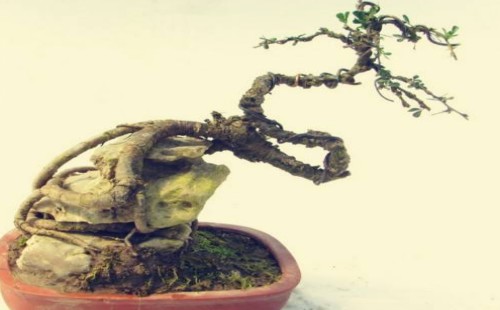
The root coiling of a Caragana bonsai is generally carried out when potting and transplanting, and the potting and transplanting process is usually carried out when the plant enters its dormant period. The transplanted seedlings can be 2-3-year-old seedlings or collected mountain stumps. If there are no suitable collected mountain stumps, then you might as well find 2-3-year-old Caragana seedlings for potting! But to make it easier to carry out root-coiling shaping, the roots usually should not be allowed to keep soil on them. After cleaning off the soil stuck to the roots, we need to comb through the long roots of the Caragana, then arrange them so that they can intertwine with each other.
However, we can also use palm fiber to bind and shape them, making them present a state of twisted and interlocking roots. Because the roots of Caragana, like its branches, are often very soft and have fairly good flexibility, as long as we apply scientific methods during the root coiling and processing, it is often a very elegant and refined process. Moreover, if the root coiling is done well, it can make the roots look vigorous and majestic, bringing viewers a delightful enjoyment. Because if the root coiling is done well, not only is the ornamental value very high, but the artistic effect and charm are also very outstanding. Therefore, for the shaping of a Caragana bonsai, the roots are an aspect that cannot be ignored.
As for the shaping methods for the roots of a Caragana bonsai, root coiling and root exposure are generally adopted, and after root coiling, there are often three forms of treating the exposed roots above the soil surface:
1. Sleeve type
The sleeve type is mainly used for Caragana bonsai that have difficulty sprouting adventitious roots. Originally, this method is generally used after pruning and shaping the trunk to achieve the effect of exposed-root shaping. Generally, ring-barking is carried out on the branch or trunk at a suitable height from the pot surface, and then a section of plastic bottle is put on it as a sleeve. Of course, some cultivation soil needs to be put into the sleeve to ensure that roots can sprout smoothly at the ring-barked area. During cultivation, pay attention to keeping the soil in the sleeve at suitable humidity. After about 2-3 years, the sleeve can be removed, and by then the roots grown from the ring-barked area are also fairly robust, enough to make an exposed-root bonsai.
2. Mound-soil type
For situations where adventitious roots can sprout from the base of the main trunk of Caragana, we can usually achieve root exposure by building up a high mound of soil at the base. This method is generally carried out during the spring growing season. By artificially scoring the base of the main trunk and then building up a high mound of soil, moisture is maintained well in order to sprout new roots. But completing this cultivation process still requires 2-3 years, ultimately achieving the goal of exposed-root shaping.
3. Raised-root type
Raising roots is a commonly used technique and aspect in the shaping process of tree bonsai, used to enhance the artistic charm and ornamental value of the bonsai. But the root-raising process is generally completed during potting or repotting, and scientific selection must be made among the roots. Generally, remove the fine and keep the strong, remove the dense and keep the sparse, but try as much as possible to retain roots that have grown in relatively unusual ways. This can better show the root form with sprawling, claw-like roots and multiply the value of the bonsai.