Detailed Explanation of Caragana Bonsai Shaping Methods and Techniques
Caragana is famous for its flowers that closely resemble a bird spreading its wings to fly, and because its blooms are golden yellow, it is also known as the golden bird flower. Caragana flowers are not only magical in shape but also very bright in color, so they have extremely high ornamental value. And caragana has therefore become a rare and precious bonsai tree species. Moreover, caragana branches are soft and highly flexible, making them easy to twist into shapes, and it is also relatively tolerant of pruning, with strong sprouting ability and very rapid growth, so people like to shape caragana bonsai into various forms for appreciation. So, how should caragana bonsai be shaped?
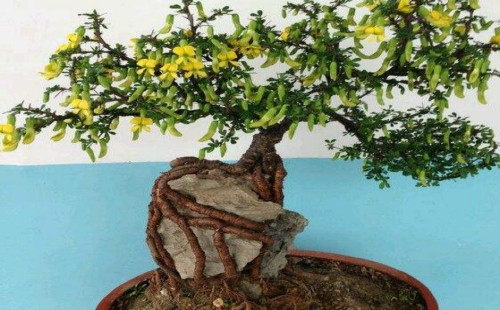
Because caragana's roots and stems are vigorous and powerful, the trunk is upright and unyielding, and the branches are highly flexible, there are many styles that can be created. Whether it is the cascade style, the forest style, or the exposed-root style, the connected-root style, and even the rock-clinging style, the curved-trunk style, and so on, all fall within the scope of its shaping applications, and it can be made into various forms of ornamental bonsai. However, whether collecting wild stumps or buying stump material from the flower market, before potting it is generally necessary to prune branches and trim roots in advance according to its tree form and shaping needs. This mainly means cutting off branches and trunks that are unfavorable for shaping as well as old, weak and damaged roots, which promotes rapid sprouting after potting while also making shaping easier.
But before turning it into a true bonsai, we still need to transplant and pot it into an ornamental pot, so what it went through earlier is a process of cultivating the stump. During this period it needs to go through processes such as shaping and root forming, and generally after 1-2 years of stump cultivation it can be potted into an ornamental pot. And the focus of shaping it often also needs to be carried out after it has survived in the ornamental pot. Below, the editor will share with you the shaping techniques for caragana in an ornamental pot!
Because caragana is tolerant of pruning, has strong sprouting ability, flexible branches and diverse shaping methods, the shaping of caragana bonsai should vary according to the material, mostly using a combination of pruning, wiring and other means. Generally, when it sprouts in the second spring, we need to carry out the first pruning treatment, mainly cutting off redundant branches that are useless in the shaping process, while also wiring some branches that are improperly directed but must be retained in order to determine their new growth direction. In addition, attention should be paid to cultivating transition branches so that the growth ratio between branches and trunk appears better coordinated, and axillary buds sprouting from the roots should be promptly removed to save nutrients and ensure that growing branches have enough nutrients to maintain rapid growth.
By the third year, the caragana tree has basically taken shape, and at this point we can choose suitable weather in spring to transplant the tree into a more ornamental pot such as a purple clay pot. After it adapts to the pot, maintenance and management should be strengthened to promote the bonsai to maintain good vigor and lay a foundation for the more detailed shaping process later. Remember that before sprouting every spring, the plant should undergo one heavy pruning, mainly cutting off overly weak branches, leggy branches, dried branches and other branches that have grown out but affect the beauty of the shape.
It should be noted that caragana bonsai generally needs repotting every 2-3 years, and this should preferably be done in early spring. When repotting, half of the old potting soil can be removed, and the roots should be appropriately trimmed, mainly by shortening overly long roots and cutting off all old, weak, diseased and damaged roots, and this opportunity can also be used to raise the roots of the bonsai so that the root area also has an ornamental shaping effect. But caragana bonsai is generally mainly grown for its flowers, so promptly doing a good job of pruning and shaping is of great significance for improving the overall ornamental value of the bonsai, especially for promoting flowering.
Caragana is tolerant of pruning and its branches are highly flexible, making it relatively easy to achieve shaping through pruning, bending, wiring and other means, and its root system is also very developed, making it convenient to raise roots and shape them. We can completely, based on the conditional advantages that caragana possesses, create tree bonsai of different shapes and styles according to personal preference. In the specific shaping process, methods such as bending, tying, climbing and binding can be used in combination to stabilize the bent parts of branches being curved, and at the same time they can be appropriately rubbed and twisted so that the branches gradually bend slowly, ultimately achieving the effect of curved shaping. But during the bending process, strong force or brute force must not be used, mainly to prevent the branches from breaking; and for sharply curved parts, the bending treatment can be carried out in multiple stages to gradually achieve the shaping requirement.