A Detailed Guide to the Timing and Methods of Leaf Removal for Goji Berry Bonsai
Leaf removal on bonsai trees is an important means of prompting species that sprout and leaf out only a few times a year to send out new growth. It keeps the bonsai tree constantly covered in fresh, tender green leaves, making it full of vitality and greatly enhancing its ornamental value. The same is true for goji berry bonsai, which often relies on leaf removal to encourage new growth. But leaf removal on goji berry bonsai cannot be done anytime or anywhere, so when should goji berry bonsai be defoliated? And how should it be done?
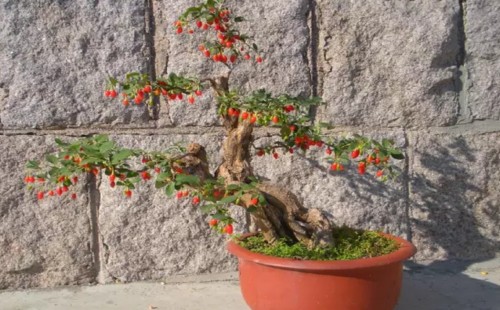
For different tree species, the timing of leaf removal is not the same; some are suited to earlier defoliation, others to later. Generally, however, leaf removal should not be carried out during spring bud break, nor in summer; it is mostly done in spring and autumn, when the results are best. Besides choosing the right timing, the method is also important. For ordinary bonsai trees, once you decide to remove leaves, you usually need to strengthen water and fertilizer management half a month beforehand to prompt rapid sprouting of new buds.
But when topdressing goji berries, adhere to the principle of "light fertilizer, frequent application"; never use too high a concentration, and never apply raw fertilizer. If leaf removal is carried out in late spring and early summer and in autumn, you often need to apply a slightly higher-concentration liquid fertilizer once a month before these two periods, which prompts the branches to quickly push out new buds, new leaves and flower buds. Leaf removal in late spring and early summer is mainly done to prompt the goji berry to sprout emerald-green tender leaves and improve the bonsai's ornamental appeal. Moreover, the goji berry has fairly strong sprouting ability, so with scientific topdressing before leaf removal, the tree readily sprouts new leaves within a short time.
In early autumn, we can carry out a second leaf removal on the goji berry bonsai. Original at this time, leaf removal is mainly done to promote flower buds and leaf buds to emerge at the same time, and by late autumn we can enjoy not only the foliage but also the fruit. At this time the green new leaves and bright red fruit set each other off beautifully, giving an excellent ornamental effect. However, although the goji berry tree has strong sprouting ability, we cannot defoliate it too many times in one year; twice is most suitable: once in late spring and early summer, and once in early autumn.
Before carrying out leaf removal on goji berry bonsai, besides topdressing in advance to boost growth, seizing the right timing and controlling the number of times, we also need to master the techniques and detailed handling during the process. Generally, for a strong-growing goji berry bonsai, the area of leaf removal can extend over the whole tree, especially when dense leaves grow on thick, sturdy branches, where leaf removal should be focused. But for weaker-growing goji berry trees or branches, the amount of leaf removal should be strictly controlled, and defoliation may even be skipped entirely.
It should be noted that when removing leaves from goji berry bonsai, it is generally not advisable to pluck the leaves directly by hand. Although it is called leaf removal, the usual requirement is to leave the petiole on the branch. Plucking by hand makes this hard to achieve, and it also easily knocks off or damages the axillary buds. So leaf removal generally requires scissors to cut off just the leaf blade directly, leaving the petiole on the branch.