How to root Schefflera cuttings quickly? A few practical tips for you
The Schefflera can be propagated in many ways. It can not only be grown from seed, but can also be propagated by cuttings, division, layering, and so on. However, whether for mass production or for home potted plant growers, cutting propagation is often the most suitable. This is because the cutting method is not only simple to perform, but also gives good survival rates, so the propagation efficiency is relatively high. But when taking cuttings, certain conditions also need to be met, providing the cuttings with a relatively suitable growing environment to raise the survival rate of the cuttings. Yet the most fundamental thing with cuttings is to speed up their rooting, so how do you get Schefflera cuttings to root quickly?
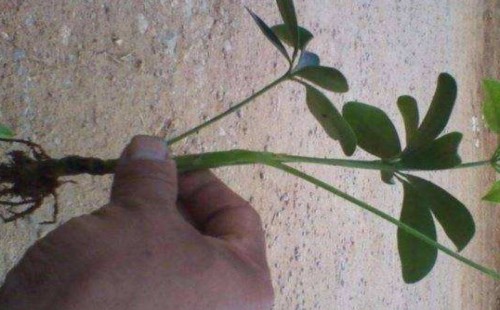
First, the cutting medium needs to be disinfected and sterilized. Usually a diluted potassium permanganate solution can be used to soak and disinfect it, with the concentration generally controlled between 0.3%-0.5%. If a plug tray is needed to propagate seedlings, the plug tray also needs to be sterilized and disinfected. This is because ordinary medium usually carries various pathogens, and sterilizing and disinfecting it in time can effectively prevent the cuttings from being infected and attacked by pathogens, thereby to a certain extent providing a guarantee for improving the survival rate of the cuttings.
If cutting propagation is carried out during the day, pay attention to the lighting in the environment. As long as the light is not strong enough, it is generally necessary to provide sufficient light to help promote photosynthesis. At the same time, it is recommended to use sterilized red clay and indoleacetic acid mixed evenly in a 1:1 ratio, making it into a paste to serve as a rooting agent. Then cut the cuttings to a length of about 8-10 cm, remove the leaves at the lower end of the cuttings, keeping only the 2 leaves at the top, then insert the lower base into the prepared rooting agent to a depth of about 1 cm. Then plant the cuttings in the cutting medium.
During the cutting period, pay attention to controlling the temperature well. Since Schefflera prefers a warm growing environment, the temperature is required to stay at 15°C-25°C, which is most suitable. Generally, when the temperature in the cutting environment is controlled at around 20°C, roots can usually emerge smoothly in 4-6 weeks, while when the temperature exceeds 25°C, it tends to easily cause the cuttings to grow leggy after sprouting. Therefore, reasonably controlling the temperature is of great significance for the normal rooting and growth of the cuttings.
And during the propagation of cuttings, in addition to controlling the temperature well, humidity management is also very important. Since the cuttings will lose some water during growth, we need to maintain the humidity in the growing environment of the cuttings by humidifying. Generally, the relative air humidity needs to be kept at around 85%, and humidifying can be done by misting. This is because the growth of Schefflera cuttings can only sprout normally in a suitable humidity environment. Of course, the humidity in the medium also needs to be controlled well, because if the humidity is too high, it is also quite easy to cause the cut at the lower end of the cutting to rot, ultimately leading to failure of the cutting.