How to graft a money tree? Detailed method and steps
The money tree is a tree species native to tropical regions, and because it has extremely high ornamental value, it can be seen in many places. Moreover, the money tree has quite a few propagation methods, with common ones including sowing, cuttings, and grafting. In a previous article, I shared with you how the money tree can be propagated into small potted seedlings by means of sowing and cuttings. So how do you graft a money tree? Today, I will share with you the grafting method for the money tree.
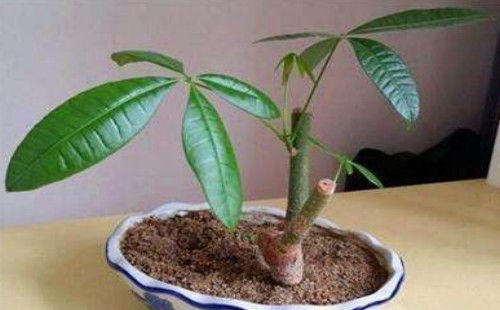
For growing it as a foliage potted plant, sowing or cuttings are generally used to propagate money tree seedlings, but if the goal is to improve the variety and promote the flowering and fruiting of the money tree, we usually need to use grafting to achieve this. This is because growing money tree seedlings from seed until they flower and bear fruit is generally quite time-consuming, usually requiring 7 or 8 years to achieve. But we can choose a 2-year-old money tree seedling as the rootstock, and then cut a vigorous 1-year-old branch from a fruit-bearing mature money tree as the scion for grafting. If all goes well, it can generally flower the following year. Calculated this way, flowering can be advanced by more than 5 years.
Although money tree seedlings can be propagated by sowing as long as the growing environment is suitable, grafting the money tree requires choosing a relatively suitable time. This is because grafting and improving money tree seedlings at the right time often results in a higher survival rate and better grafting results. For grafting the money tree, the cleft grafting method is generally used, and the survival rate of grafted seedlings can even reach more than 80%, making it a relatively efficient propagation method. Now let us take a look at the grafting process for money tree seedlings!
1. Making the scion
From a normal flowering and fruiting mother money tree, select and cut a vigorously growing 1-year-old branch as the scion. The scion is required to have 1-2 buds, then make one cut on each side below the buds at a suitable angle, so that the two cut surfaces form a wedge shape. Note that the force should be even during cutting, until the cambium of the scion is visible, and try to make the cut in one go, avoiding additional cuts.
2. Rootstock treatment
For grafting the money tree, a young money tree is mostly used as the rootstock, then the upper part of the main trunk is cut off at a position about 40 cm above the ground. Then make the grafting incision by cutting at a position 1-2 cm slightly below the cut surface. Use a sharp blade to make a longitudinal diagonal cut into the main trunk until the cambium is visible. Note to keep the length of the diagonal opening as consistent as possible with the diagonal cut surface of the scion.
3. Grafting process
Insert the wedge-shaped end of the prepared scion evenly into the incision of the rootstock, so that the wedge-shaped opening of the scion fits fully with the incision of the rootstock. Of course, sometimes the incision of the rootstock is inevitably larger than the wedge-shaped opening of the scion, so at this time the scion can be moved to one side, so that the cambium of the rootstock and the cambium of the scion are in the closest possible contact to the greatest extent, which is more conducive to the sprouting and survival of the grafted seedling.
4. Tying with tape after grafting
After completing the main work of grafting, we also need to use plastic film to wrap and tie the grafted part, and this step is equally very important. The purpose of wrapping with plastic tape is to make the rootstock incision and the scion incision at the graft union contact more fully and tightly, so they will not easily loosen; at the same time, it can also prevent rain and dew from soaking the graft union and causing infection by pathogens. If all goes well, in about 1 month we can see the scion sprout. In this case, we need to loosen the binding at the grafted part in time, and if necessary, we should also remove the plastic tape in time to avoid affecting the sprouting and growth of the grafted seedling.
At this point, the grafting process for the money tree is complete, and what needs to be done afterward is maintenance and management work. As for how the grafted seedling grows later, it is mainly directly related to whether the later maintenance and management work is done properly. The grafting process for the money tree is exactly the same in method as grafting for many other tree species. As long as you grasp the details, there generally will not be any mistakes. You might as well try it more, after all, practice makes perfect.