Can a money tree (Zamioculcas zamiifolia) be propagated by whole-branch cuttings?
The practical value of a potted money tree is very high, and it is generally appreciated as an indoor foliage potted plant. Moreover, propagating the money tree is relatively simple. Since the plant has underground tubers, and the tubers bear latent buds, propagating it from tubers or by division makes it quite easy to obtain small potted seedlings. In addition, the money tree can also be propagated by cuttings to produce small potted seedlings, so can a money tree be propagated by whole-branch cuttings?
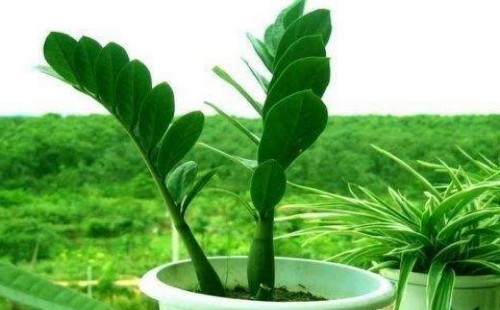
In fact, the cutting propagation process of the money tree is also relatively simple, with no strict technical requirements, but it does have certain requirements for the growing environment. As for whether the money tree can be propagated by whole-branch cuttings, it clearly can. However, we also need to note that if we cut off a whole branch of the money tree for rooting cuttings, the stems and branches are often rather long and carry many leaves, which tends to increase the difficulty of rooting to a certain extent.
First of all, if the stems and branches are too long for rooting cuttings, they are not very easy to secure on the cutting bed, since the weight of overly long stems and branches cannot be ignored, and after all, the stems and branches carry a large number of leaves. And precisely because there are so many leaves, the amount of water evaporation is relatively greater. Based on these two points, this often brings a certain degree of difficulty to the rooting and survival of the stems and branches. So in a sense, the money tree is not very suitable for whole-branch cuttings.
Generally, we can cut the stems and branches of the money tree into lengths of 10-30 cm for rooting cuttings, and they can be rooted either in water or in soil; as long as the method is correct, small potted seedlings can usually be obtained. In addition, we can also propagate by leaf cuttings, that is, cutting off the money tree's leaves together with the petioles, and even with a small section of stem attached, and inserting them into moist sandy soil. For leaf cuttings, the stem section, petiole and leaf base should all be buried in the sandy soil, which makes sprouting and survival easier.
Of course, if we insist on using whole-branch cuttings of the money tree, that is also possible. Original, but all the preparatory work needs to be done well, and after planting the cutting we must find a way to secure its long stems and branches so that they stay nearly upright and do not topple over. At the same time, we need to do a good job of misting to keep moisture, since the stems and branches carry many leaves and transpiration is pronounced. Doing a good job of moisture retention can prevent the stems and branches from dehydrating and affecting survival.
Generally, in order to reduce the burden on the stems and branches themselves, which affects the sprouting and survival of the cuttings, we can cut a section of stem and branch while keeping just one pair of leaves, and in particular we need to cut off the leaves at the lower end of the stem and branch. Then cut the end used for rooting into a slanted cut, apply a layer of plant ash and rooting powder to the wound, let it dry for a while, and after the wound has basically sealed, bury it in moist fine sand. Likewise keep the temperature steadily at around 25°C, and do a good job of shading and moisture retention; generally in a little over 2 weeks it will successfully take root and survive.