How often is it appropriate to change the water for hydroponic pothos?
Pothos can be grown not only in soil but also hydroponically, and the most worrisome part of hydroponic pothos is changing the water. If the water is changed scientifically, it is of great significance to its growth; otherwise, it may have a negative impact on its growth. So how often is it appropriate to change the water for hydroponic pothos?
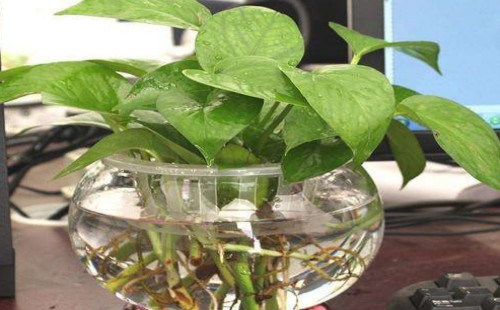
Pothos prefers a clean growing environment. Even in hydroponics, it often needs frequent water changes to ensure the water stays clean and keep the plant growing vigorously. As for how often hydroponic pothos needs its water changed, there is often no uniform and fixed pattern, since under different seasons it is often affected by temperature and many other factors, and the frequency of water changes should also be controlled flexibly.
Changing the water for hydroponic pothos plays a crucial role in whether it can maintain good growth. In general, water changes can be decided according to how clean the water in the container is. If the solution used for hydroponics has already become somewhat cloudy, or if some slime and other impurities have formed on the roots or the inner wall of the container, then we need to promptly replace it with clean fresh water.
But if the pothos's water-grown environment stays clean with no impurities and no pollutants for a long time, then the time between water changes can be slightly postponed. The factors affecting water change frequency include not only temperature, time and current condition, but also the different stages. Generally, in the early stage of hydroponics, fresh water can be changed once every 2-3 days; after the plant has successfully sprouted roots, water can be changed once every 3-5 days; and in the later stage, fresh water can be changed once a week.
But if it is in summer or winter, often affected by temperature, the original water change frequency also needs to be appropriately increased or decreased. Generally in summer, because pothos has large leaves and the temperature is relatively high, water loss is more serious and the water quality tends to deteriorate easily, so the water change frequency should be appropriately increased; if it is winter, often because the temperature is lower, water consumption is relatively less, and turbidity is not likely to occur in the short term, so the water change frequency should be much lower.
Moreover, the frequency of water changes is also very important to the growth of pothos. If the water is changed too frequently, the plant often has to constantly adapt to a new water quality environment, and it also causes a waste of resources, and a high water change frequency is also very troublesome; but if the water change frequency is too low, the water quality is often damaged and prone to breeding bacteria, thereby affecting the normal growth of the plant. Therefore, changing the water for hydroponic pothos should be flexibly controlled, avoiding changing the water too often or too lazily, otherwise both will bring negative effects on the normal growth of the plant.