How long does it generally take for Chinese sweet plum (Sageretia thea) air layering to root?
Air layering is a very efficient means of obtaining small bonsai stock. For tree species like Chinese sweet plum (Sageretia thea) when cultivating raw stock, it often achieves twice the result with half the effort. This is mainly because propagating small Chinese sweet plum bonsai stock through air layering has a very fast rooting speed, making it easy to obtain stock that can be transplanted into pots. So, how long does it take for Chinese sweet plum to root when propagated by air layering?
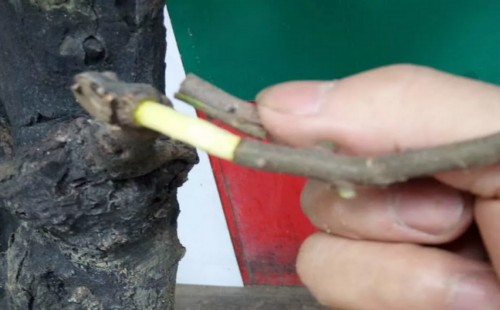
In fact, air layering propagation of Chinese sweet plum is similar to that of Chinese goldberry (Diospyros cathayensis), and the operating procedure is exactly the same. Therefore, in order to achieve the goal of cultivating small Chinese sweet plum raw stock through air layering, we might as well try the same approach as air layering propagation of Chinese goldberry. Through air layering propagation, not only can the excellent traits of the mother plant be preserved, but the survival rate is also very high, making it a fast and efficient asexual propagation method.
In many previous articles, the editor shared with everyone the methods of air layering propagation for potted plants, which will not be repeated here. Compared with traditional cutting methods, air layering propagation has more obvious advantages: air layering can be used to achieve propagation directly on thicker branches; the safety factor of air layering propagation is very high, and even if rooting is not successful, the branch will not die as a result; the native variety produced by air layering propagation can inherit the excellent characteristics of the mother plant and will not easily change the genes of the variety.
If we can carry out air layering propagation of small Chinese sweet plum raw stock according to scientific methods, at the fastest it generally takes just over a week to promote rapid rooting, and at the slowest it usually roots within one month. This is often a growth effect that propagation methods such as sowing and cutting cannot achieve. Therefore, the advantages of air layering propagation of Chinese sweet plum are very obvious, and it is a breeding method very worth promoting and applying.
The simple procedure is: generally only a robust branch is needed, scientific girdling is carried out, then moist soil is used to wrap the girdled position, and finally the mother plant is managed according to normal care methods. After the wound at the girdled position heals, forms a callus and roots, we then cut off the rooted branch and plant it in a pot to continue cultivating it in the pot.
However, although air layering propagation of Chinese sweet plum roots quickly and makes it easy to obtain small potted seedlings, air layering propagation has relatively high technical requirements. We need to do sufficient preparation in normal times and only formally carry out the operation after proficiently mastering this skill. In this way, rooting is often accelerated more, and the success rate can be greatly improved. At the same time, we not only need to master this skill, but also need to do a good job in the care and management during the air layering period, creating a comfortable growing environment for air layering propagation, so as to achieve twice the result with half the effort.