How to propagate pothos the fastest? A few practical methods to teach you
Pothos is an evergreen plant that is very suitable for foliage display, with very high practical value, as everyone can see, and pothos is also very easy to propagate, grows very quickly, and with just a little careful management it can be grown into a full pot. So, how do you propagate pothos the fastest?
1. Determine the hydroponic timing
Pothos is an evergreen plant, usually able to be propagated in all four seasons, but the temperature environment in spring and autumn is more suitable, and the propagation survival rate is higher. Because the temperature is too high in summer and too low in winter, both often have a certain impact on plant growth, so propagating small seedlings is relatively more difficult. Therefore, it is most suitable to carry out in spring and autumn.
2. Choose hydroponic branches
Since we are using the method of hydroponic induction of rooting followed by transplanting to achieve the propagation of pothos seedlings, we first need to choose branches for hydroponic rooting induction as cuttings. Although pothos can also be propagated using thick leaves, cutting healthy branches for water propagation usually has more advantages.
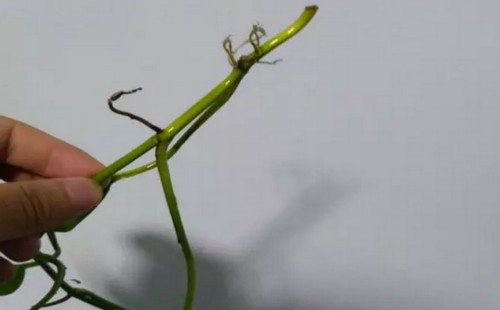
The requirement is to cut healthy, fresh branches with aerial roots from the mother plant as cuttings. Generally, use scissors to cut branches about 20 cm long as cuttings, and at the same time remove the excess leaves at the lower end when water propagating.
3. Set up the hydroponic environment
In order to achieve the effect of hydroponic rooting induction, we can prepare an empty plastic bottle, then put an appropriate amount of mineral water in it, or use purified water. Of course, if there is no water source with such water quality, we can also use ordinary clear water. If using tap water, let it sit for 2-3 days in advance before use.
4. Water propagation to induce rooting
After setting up the hydroponic environment, insert the prepared pothos cuttings into the bottle, so that the stem segments at the lower end of the cuttings are all submerged below the water surface. Then place the bottle in a cool location, while paying attention to controlling the ambient temperature and changing the water regularly. To speed up growth, some nutrient solution or auxin can also be applied. Generally within 1 month, we can see the aerial roots on the pothos cuttings gradually growing into relatively well-developed root systems. When these roots gradually turn black, we can transplant them into flower pots for soil cultivation.
5. Transplanting small seedlings into soil
The process of transferring pothos from hydroponic conditions to soil cultivation is very simple. You only need to take it out of the water, then transplant and plant it into potting soil just like an ordinary plant seedling. After transplanting, water once thoroughly, then place the flower pot in a cool, ventilated place to recover. At the beginning, keep spraying some water on the leaves every day to maintain moisture, but try to water as little as possible. Generally wait until new leaves begin to emerge after 1 week before resuming normal watering.