How to bend a Chinese plum (Sageretia thea) bonsai? Detailed explanation of the correct methods and techniques
The ornamental value of the Chinese plum bonsai is very high, mainly reflected through its perfect styling design. For tree bonsai, bending is a commonly used technique in the styling process, which can shape the branches and trunk of the bonsai tree into various graceful and vivid styling effects. But bending must be done according to the material, and should not be done blindly, otherwise it will not only fail to achieve the effect we need, but may also cause a waste of resources, or even affect growth. So, how do you bend a Chinese plum bonsai?
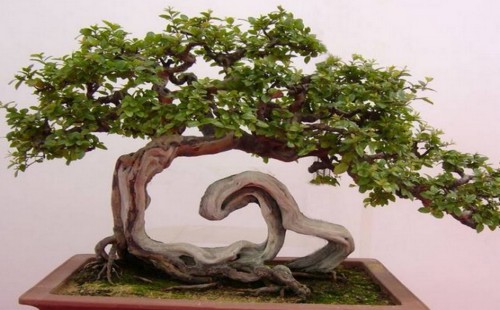
For smaller branches, bending can generally be done directly according to the styling needs; but for thicker and sturdier branches, the branch usually needs to be split first before bending can be done. However, for the Chinese plum bonsai, pruning is generally used for styling. This is because with bending, small branches tend to be too brittle and break easily, while large branches tend to be too hard, making the bending technique quite difficult to carry out. So even when bending a Chinese plum, we need to pay attention to technique.
First, there are certain requirements for choosing the bending target. Generally, bending can only be done on current-year branches when they are about to become woody. For old branches, bending is very difficult and almost impossible to carry out. If you force bending on an old branch, it is very likely to break it, and because of its high hardness, it is also not easy to achieve the bending effect we need. Therefore, the target to be bent should be a current-year branch, and it is only suitable to use this method when it is about to become woody.
After selecting a suitable branch for bending, split the branch partway down the middle, and then bend it. Or use a sharp blade to shave off part of one side of the branch, and then bend it. Of course, some hobbyists have also tried using fire to scorch it, or using a larger branch bender to assist in completing it, and both are feasible. The only thing is that the degree of bending needs to be controlled well, and it should not be forced; doing it just right is best.
In addition, a rather rough method can also be used, which is to twist a moderately sized branch like a fried dough twist so that the branch cracks, and then bend it. After the degree and angle of the branch's bending reach the effect we need, fix it in place, and then wrap it with aluminum foil or electrical tape. With this method, the branch thickness is often required to be appropriate and not too large, otherwise the branch cannot be twisted to crack.