When Is the Best Time to Defoliate a Chinese Elm Bonsai?
There are many types of bonsai trees suitable for defoliation, and the Chinese elm (Sageretia thea) is one of them. For tree bonsai, defoliation naturally has its benefits: it not only makes new leaves grow smaller and more pleasing to view, but also lets the bonsai display several different ornamental states throughout the year. Of course, though we call it defoliation, it is also recommended to use scissors to cut the leaves off, and defoliation is suitable for strong trees; weak trees are not suited to defoliation.
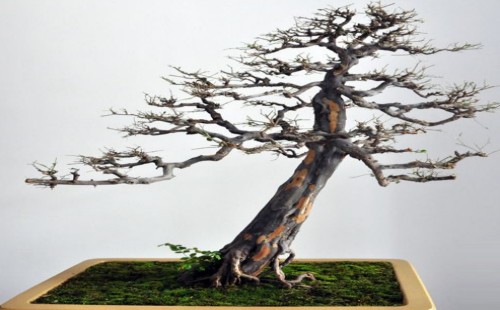
Moreover, for bonsai trees, whether deciduous or evergreen species, the timing of defoliation must be grasped well. Defoliation cannot be carried out in all four seasons, and it also depends on the tree's current growth state and stage. If you defoliate blindly, not only will the bonsai tree fail to achieve the growth effect we want, it may even produce the opposite result. So when should a Chinese elm bonsai be defoliated?
The purpose of defoliating a Chinese elm bonsai is naturally to better promote the sprouting of new buds and the emergence of new leaves. Now that autumn has arrived again and the weather is getting cooler, the Chinese elm has also begun to show leaf drop. So if we defoliate it at this time, we can even remove all its leaves. Doing so not only saves nutrient consumption and lets the plant accumulate more ample nutrition for the next round of sprouting, but the bare Chinese elm bonsai also has a distinctive charm of its own.
For a bonsai tree like the Chinese elm, defoliation is a very necessary task. But choosing the best time to defoliate often gives better growth results; usually the most suitable time is after the Mid-Autumn Festival, and after defoliation you should apply additional fertilizer appropriately and control light appropriately. As long as we can carry out scientific defoliation of the Chinese elm bonsai at the right time, the plant will sprout better afterward and the bonsai's ornamental value will be higher.
But note that after defoliation, a Chinese elm bonsai must not be exposed to direct strong light, and even less should it be placed in the sun for long periods of scorching; instead it should be shaded appropriately, placed under tree shade as much as possible to recover, with a little weak light provided in the morning and evening. If defoliation and care are managed properly, the leaves can grow back after a few weeks.