A detailed guide to sowing Ranunculus asiaticus: even beginners can learn it easily
Ranunculus asiaticus, also known as Persian buttercup, not only has many varieties and rich flower colors, but also blooms in a very showy and fragrant way, with especially high ornamental value. It can be used for cut flowers or grown in pots, and both bring us a delightful enjoyment. Moreover, Ranunculus asiaticus is a flowering plant that can bloom and set seed, and its seeds can also be harvested for sowing!
However, if we want to successfully grow Ranunculus asiaticus seedlings, we still need to master certain seedling-raising methods. Because Ranunculus asiaticus is a plant that can go dormant, when the sowing method is improper, it is difficult for it to sprout. Today, the editor will share with you the sowing method for Ranunculus asiaticus, hoping it will be helpful to everyone.
The sprouting of Ranunculus asiaticus is affected by factors such as temperature, humidity, and light. If these conditions cannot be met, sowing propagation will inevitably be difficult to succeed. Since autumn is the best propagation season for Ranunculus asiaticus, whether in terms of temperature, humidity, or light, conditions can often be fully guaranteed, which is extremely favorable for the smooth sprouting of the seeds.
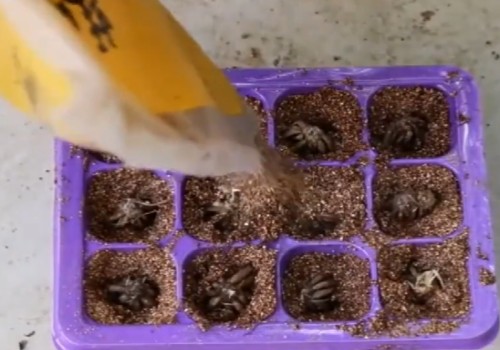
The sowing propagation of Ranunculus asiaticus is generally carried out in a seedling tray, which can be bought everywhere online. For the original selection, just choose the 12-cell plug tray version. Because the success rate of sowing propagation for Ranunculus asiaticus is relatively low, it is recommended that everyone use a seedling tray for propagation and sow more seeds, so as to make up for the shortcoming of a low sprouting rate.
For the seedling substrate, pure vermiculite can be chosen, that is, vermiculite without any impurities, because it has good air permeability and water retention and is very suitable for rooting under sowing propagation. After filling the vermiculite into the seedling tray, use a spray bottle to wet the substrate in the plug tray for later use.
Next, we also need to carry out the necessary simple treatment of the Ranunculus asiaticus corms. Because the corms of Ranunculus asiaticus are all shaped like small claws, and if purchased, they are also very dry, as if they had withered to death. But that is actually not the case. In this situation, the seeds are in a dormant state, and before sowing, we need to activate them from dormancy.
The method to activate the Ranunculus asiaticus corms is relatively simple: let them fully absorb water and swell. We have just moistened the substrate in the seedling tray with water, so now we do not need to soak the Ranunculus asiaticus seeds. After poking small holes in the substrate, simply bury them directly into the moist substrate.
After all the corms have been buried, we then cover the seedling tray with a layer of vermiculite. After covering with vermiculite, there is no need to water them either. The purpose of burying the seeds into the moist substrate in the seedling tray like this is actually to activate the seeds from dormancy. After the seeds are activated, as long as the growing environment is suitable, they will gradually take root.
After the Ranunculus asiaticus corms take root, they will gradually put out one or two tender leaves, and these tender leaves are the cotyledons. As they continue to grow, the cotyledons will gradually develop into true leaves. Although this process sounds relatively fast, in fact the process of activating the seeds also takes about 3 days. During this period, do not pull the seeds out with your hands to check their condition, because once the seeds are exposed to light, they will die.