Detailed explanation of plum blossom bonsai shaping techniques, easily create beautiful bonsai
The ornamental value of old-trunk plum blossom bonsai is very high, but to create a beautiful plant shape and fully reflect its ornamental value and artistic charm, it is difficult to achieve without years of cultivation and shaping. The two most important methods involved in the shaping process of plum blossom bonsai are pruning and tying. Today, the editor will share with you the shaping techniques for plum blossom bonsai.
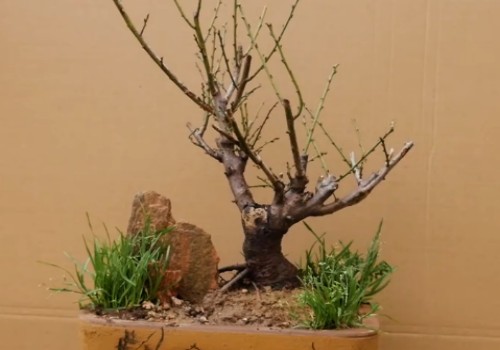
As the editor just mentioned, the shaping of plum blossom bonsai is mainly carried out through pruning and tying. Plum blossoms usually bloom in winter and spring, and they bloom before growing leaves. Their flower buds mostly form in the summer and autumn of the previous year. If we prune before budding in early spring, we often cut off flowering branches and knock off flower buds. Therefore, pruning of plum blossoms is generally suitable within 1-2 weeks after the flowers fade.
If pruning at this time, since the plant has already begun to gradually resume growth, the sap flows relatively quickly within the tree, and the plant is full of vitality, the extent of pruning should not be too large, and the degree should not be too deep. Moreover, during the previous flowering process, the plant consumed too many nutrients. Pruning can save some nutrients and concentrate them for supply to new buds, but it still cannot meet the needs of growth and sprouting. Therefore, after pruning, it is still necessary to combine topdressing for maintenance.
The root system of plum blossoms is relatively developed. They are not only relatively tolerant of pruning, but also have strong sprouting ability. In particular, leaf buds sprout very quickly, and it is relatively easy to form branches. Flowering branches also vary in length, and we can divide them into three forms: long, medium, and short, but generally flowering branches within 20 cm have the best flowering effect, abundant and beautiful. Of course, short flowering branches with a total length of 2 cm can also bear flowers, but on long flowering branches of more than 30 cm, there are generally very few flowers, and even if there are flowers, they often only appear at the tips of the branches.
For a tree species like plum blossom, its flower buds usually form on current-year branches. Latent buds mostly appear on old branches and can form short flowering branches and bloom. However, the main branches of plum blossoms often grow very vigorously but cannot form flower buds, because their focus is on growing branches. Therefore, we can properly shorten these long branches, which can promote the sprouting of side branches. By the summer and autumn of the following year, the newly formed side branches will become flowering branches and form flower buds.
Of course, in the process of shaping and pruning plum blossom bonsai, in addition to shortening overly long branches to promote the sprouting of flowering branches, we also need to cut off useless water sprouts that are instead likely to ruin the plant shape. If we encounter weak-growing branches, diseased and pest-infested branches, overlapping branches, crossing branches, obstructing branches, and other undesirable branch forms, we should also cut them off without hesitation. This can not only save nutrients and promote the sprouting of new branches, but also improve the ventilation and light transmission of the bonsai, allowing the plant to grow with lush branches and leaves later.
In addition to pruning, we also need to appropriately use tying or binding methods to strengthen the shaping effect of the bonsai. Since new plum branches relatively easily maintain upward natural growth, in order to make the tree posture more elegant, it is sometimes necessary to use ropes to tie some branches so that they extend in the growth direction we need and bend according to our will, thereby achieving a relatively good ornamental effect.
However, for the shaping of plum blossom bonsai branches, it is usually required to be true and natural. For example, when making branches grow upward, it is generally not advisable to exceed three bends. Moreover, in the specific shaping process, it is best to combine pruning with tying, which often achieves twice the result with half the effort, and the bonsai shape is also more vigorous and antique, with a more elegant posture.