Correct pruning method for bonsai plum blossoms after flowering
For potted plum blossoms, if we do not have special shaping requirements, we only need to flat-prune their branches every year. With flat pruning, they can be trimmed into a shrub shape or an arc shape. But if it is post-flowering pruning, there are many more details we need to handle, especially for bonsai plum blossoms, where post-flowering pruning is very important. So, how do you prune bonsai plum blossoms after they flower?
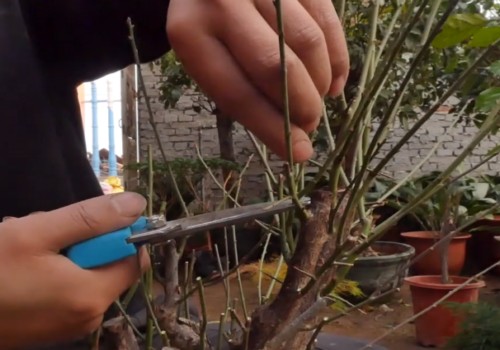
Overall, post-flowering pruning of bonsai plum blossoms must be done promptly and early, otherwise it may affect the flowering effect the following year. For post-flowering pruning of bonsai plum blossoms, we mainly, or with emphasis, handle the following aspects well:
1. Correctly grasp the timing of pruning
For post-flowering pruning of bonsai plum blossoms, generally do not wait until all the flowers have withered before proceeding; generally, start pruning when some flowers begin to wither. This is because plum blossoms sprout after the flowers have completely withered. If you wait until all the flowers on the plant have withered before pruning, the plant will already have started sprouting, and pruning at this time will inevitably affect the plant's normal growth.
Because plum blossoms are cold-tolerant, generally bloom first and leaf out later, and have a relatively strong sprouting ability, they are also relatively tolerant of pruning. Generally, cut when the flowers begin to wither and their ornamental value drops sharply, when the plant's leaf buds have not yet started to sprout, so pruning at this time will not bring adverse effects on the plant's normal growth, let alone affect the flowering effect of the coming year.
2. Accurately judge the extent of pruning
For post-flowering pruning of bonsai plum blossoms, you must be willing to be ruthless. First, try to cut the flowering branches as short as possible, keeping only 2-3 buds on each flowering branch and cutting off all the rest. Also, flowering branches that have not yet had time to bloom, as well as diseased, pest-affected and weak branches, must be cut off, so that the saved nutrients can be concentrated and transported to the new buds, thereby allowing the new buds to grow better.
If you do not prune this way, because the plant consumes relatively more nutrients during the flowering period, the new buds cannot obtain sufficient nutrients and energy to sprout, resulting in weaker growth, so by the coming year they cannot smoothly produce more flower buds, and the flowering effect will also be affected. Not only that, even branches that grow very robustly but are too long, too numerous and likely to ruin the plant shape must also be cut off, which can also improve the ventilation and light penetration of the bonsai, making it more conducive to the plant's growth.
After post-flowering pruning, plum blossoms can not only save nutrients but also stimulate the plant to sprout new buds and quickly form new branches. Of course, relying only on the saved nutrients is not enough to make the branches grow better. At this time, a compound fertilizer with relatively balanced nitrogen, phosphorus and potassium should be applied as a top dressing to supplement nutrients. Moreover, after the new buds grow into branches, appropriate pruning is also needed, mainly cutting off branches that grow weakly, are in poor condition, or affect the plant shape. At the same time, overly dense branches also need to be appropriately thinned, reasonably retaining some strong buds.
In summary, for post-flowering pruning of bonsai plum blossoms, the principle of “better early than late” is generally adopted. Do not wait until the flowers have completely withered before pruning, because if you cut too late, the plant's leaf buds will already have sprouted quite a lot, the leaves will also have grown relatively large, and more nutrients will have been consumed. The growth of the remaining buds will inevitably be relatively weak, and naturally far fewer flower buds will be produced later. Therefore, after post-flowering pruning is finished, fertilizer also needs to be applied in time to solve the problem of insufficient nutrients.