Plum Blossom Bonsai Styling Techniques: How to Create a Fine Plum Blossom Bonsai
The plum blossom not only has a long history in our country but also carries rich cultural heritage, making it an excellent material for creating bonsai. And appreciating plum blossoms should naturally not be separated from the history and culture of the plum, and what plum blossom bonsai pursues is beauty of form, beauty of artistic conception, and beauty of harmony. Therefore, the plum blossom bonsai we see generally has particular placement requirements, its styling is full of elegance and interest, and it can also display outstanding temperament and charm.
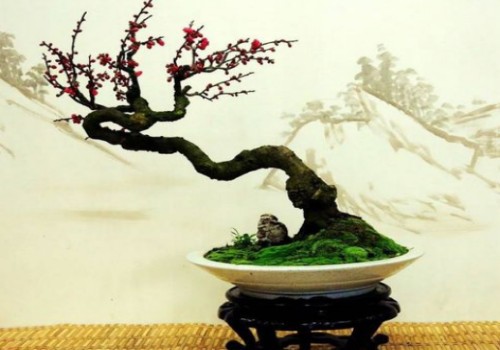
However, creating plum blossom bonsai usually uses old stumps as material, as this better reflects its beauty of form and beauty of charm. When it comes to styling, plum blossoms can generally be shaped into various styles that are completely different from one another. Taking just the styling of its trunk as an example, forms such as curved-trunk style, slanting-trunk style, lying-trunk style, cascade style, and weeping-branch style are all relatively common styling patterns. Moreover, its branches and roots can likewise be shaped into different styles.
In terms of styling methods, we can usually rely on techniques such as binding and wrapping, pruning, branch pulling, and bending to carry them out. Some can use a certain method alone, while others can use multiple methods in combination, with the ultimate goal being to make the plum blossom bonsai achieve the effect we need. But usually, binding and wrapping and pruning are often the two most frequently used among the many methods, and generally during the styling process the two are used in combination.
The styling of plum blossom bonsai strives to achieve truthfulness and naturalness, not only for the main trunk but also including the branches and the root system. But the basic characteristics of plum blossom bonsai styling are old trunk with curved branches, gnarled roots, and sparse blossoms here and there, with this effect being considered superior and quite valuable for appreciation. If we let plum blossoms grow freely without timely artistic processing and styling treatment, not only will there be no good posture to appreciate, but it will also result in a situation where they do not bloom.
Therefore, the styling treatment of plum blossom bonsai requires mastering and adhering to the basic principle of "styling according to the tree, guiding according to the situation." On the one hand, the main trunk needs to be finely crafted to achieve a shaping effect, making it appear vigorous and elegantly antique, with ever-changing posture, thereby bringing us a charm of a withered tree encountering spring. But in the process of processing and shaping, it must not be excessive; we should follow the laws of natural growth, avoid or minimize traces of artificial carving as much as possible, and organically combine artistic charm with natural appeal. Only in this way can a bonsai work become poetic and picturesque, worthy of being called an excellent piece.
On the other hand, the styling of plum blossom branches and leaves should also draw on the artistic forms of expression and methods of famous masters through the ages, so as to better reflect the special qualities and heritage of the plum. But usually, the artistic processing and styling treatment of branches mainly relies on pruning, with binding and wrapping as a supplement, which can make the distribution of branches appear more beautiful and natural. Moreover, the styling of branches should discard the overgrown and tangled, making them appear lean and with reasonable density and well-arranged spacing. It is advisable to retain 3-5 main branches on a bonsai work, and side branches should be kept or removed according to the tree's vigor as appropriate. The plum blossom bonsai created in this way can be called a fine piece.