What are the representative tree species and artistic styles of Shanghai-style bonsai?
Shanghai-style bonsai is one of the excellent traditional arts of the Han ethnic group, and is a bonsai art school named after Shanghai. It embodies literature and aesthetics, and integrates plant cultivation science, plant morphology, plant physiology, garden art and plant modeling art.
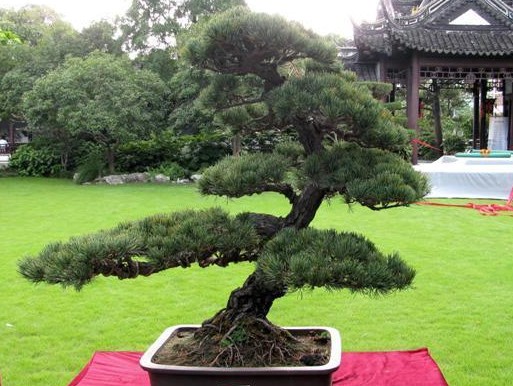
The distribution range of Shanghai-style bonsai is mainly in Shanghai and its surrounding counties and cities. Shanghai is China's largest industrial and commercial city, and also one of the largest cities in the world. Shanghai is located in the delta zone of the lower reaches of the Yangtze River, where the Yangtze River flows into the sea, with convenient water and land transportation. The climate is mild, with four distinct seasons, and it has the characteristics of a maritime climate. The superiority of natural conditions and the development of economy and culture are the main factors in the formation of the Shanghai-style bonsai school.
Representative tree species:
Mainly evergreen conifers: five-needle pine, Buddhist pine, black pine
Artistic style:
The modeling characteristic of Shanghai-style bonsai is freedom of form, not bound by rules, without any fixed pattern, emphasizing naturalness and picturesqueness, being exquisite and vigorous, bright and smooth. The branching of Shanghai-style bonsai includes natural style and round-disc style. Although some tree bonsai form round discs, they are different from the clouds and cloud discs of the Suzhou and Yangzhou schools, mainly manifested in the variety of disc shapes, differing sizes, and greater numbers, with natural distribution, gathering and scattering, density and sparsity, and attention to variation, so the form still tends toward naturalness.
Shanghai-style bonsai also takes the myriad forms of ancient trees in nature as models, refers to the branch-painting methods of Chinese landscape painting, and makes the best use of the situation to carry out artistic processing, endowing the works with more natural bearing. Therefore it has the effect of “though made by human hands, it seems like heaven's creation”. Shanghai-style bonsai is one of the first schools in China to use metal wire to process bonsai. After winding metal wire around trunks and branches, bending and modeling are carried out; the branch method of pruning and tying adopts coarse tying and fine pruning, with both pruning and tying applied, making shaping easy, with smooth formed lines and a blend of hardness and softness.
The modeling forms of Shanghai-style bonsai are relatively natural and not limited by any fixed pattern, so its modeling forms are diverse. The main ones include straight-trunk style, slanting-trunk style, curved-trunk style, waterside style, cliff style, withered-trunk style, connected-root style, stone-attached style, as well as multi-trunk style, double-trunk style, combined planting style, forest style, and flower-viewing and fruit-viewing bonsai. In addition, there is also a kind of “stone-dotted style” bonsai, in which the coiling of the trunk is combined within the tree bonsai, with exposed roots paired with mountain stones, to increase the charm of mountain wilderness.