An Analysis of the Artistic Characteristics of Shanghai-Style Bonsai Works
Although Shanghai-style bonsai was developed and formed after the founding of the People's Republic of China, it also has a historical tradition. As early as the Ming Dynasty, there was a man in Shanghai named Zhu Sansong who selected and pruned flowering trees; though they stood less than a foot tall, they were marvelously elegant and aged, possessing the momentum of a coiled dragon stretching a hundred feet. Some bonsai experts and enthusiasts in Shanghai were already devoted to studying the art of landscape bonsai as early as the 1930s.
In recent years, Shanghai-style bonsai has made new breakthroughs in conception and composition, focusing on the depiction of artistic conception. For example, when expressing distant mountains, no trees are planted on the rocks; only small grasses such as half-pennywort are grown, along with a spread of green moss. Attention is paid to small ornamental pieces such as pavilions, boats and bridges carved from Qingtian stone. In the pot, the mountain rocks have gentle slopes and winding banks, and the water surface is vast, making the sky appear high and distant and the misty waves boundless, presenting the artistic conception of "the spring breeze again greens the southern bank of the river."
The artistic characteristics of Shanghai-style bonsai works mainly include the following points:
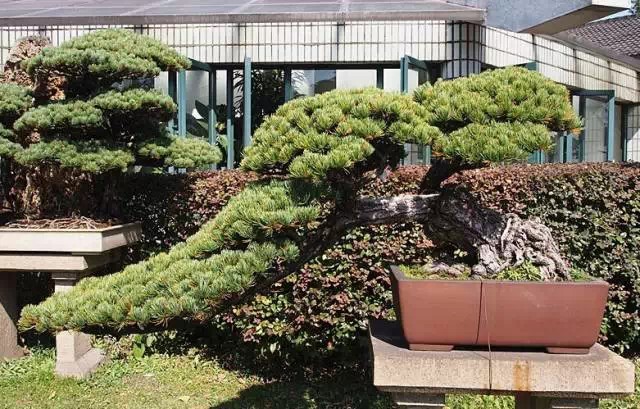
First, learning from nature, aged and picturesque. Bonsai originates from nature, but it is not a displacement or reproduction of natural scenery; rather, it is a conception based on the principles of nature and the selection of meaning according to form. Through careful design and processing, bonsai elements such as beautiful mountains, lovely waters, hills and gullies, forests, exotic flowers and unusual grasses are elevated from their natural state to an artistic form. The various types of bonsai works of the Shanghai style are precisely such artworks that follow nature yet surpass nature. Among them, trunk bonsai are mainly evergreen pines and cypresses, with more than 140 kinds of tree material. Trunk bonsai are shaped by processing with metal wire in combination with other tools. The basic technique is "careful binding and fine pruning"; the bends of the trunk and main branches mostly form smooth "curves," with both bends and extensions, bending and extending freely; the side branches mostly form vigorous "broken lines," combining hardness and softness, with hardness and softness complementing each other.
The overall tree momentum of the trunk bonsai shows no trace of artificial contrivance, appearing simple and vigorous, upright and elegant. For example, many trunk bonsai in the bonsai garden of Shanghai Botanical Garden are over a hundred years old and are rare artistic treasures, enjoying a high reputation at home and abroad. The processing of mountain stones also follows nature, applying methods according to the stone. According to the geological structure of different mountain stones, different binding methods are used for processing, with fine and natural textures, perfect and natural. Miniature bonsai likewise follow nature, revealing the large within the small, excelling nature's workmanship, and are very popular among people.
Second, reasonable layout, rich in variation. Natural landscapes are ever-changing, yet they also follow rules. To display the elegance of nature within a tiny pot and enhance the aesthetic effect, reasonable layout is crucial. The layout of Shanghai-style bonsai places great emphasis on thematic quality, layering and variability, avoiding the drawbacks pointed out in the "Twelve Taboos of Painting": "arrangement too cramped; no distinction between near and far; mountains without spirit veins; water without source or flow; scenery without safety or danger; stones with only one side; trees with few four branches," and so on. The height of mountains, the unevenness of trees, the twists of banks, the steepness or gentleness of slopes, the narrowness or breadth of water surfaces, as well as the natural charm of virtual and real, far and near, motion and stillness, are all expressed vividly and fully.
In particular, landscape bonsai has especially refined layout and composition. It absorbs the "scattered-point perspective" method of Chinese painting, making the bonsai materials and ornamental pieces staggered and well-arranged in the pot: reclining peaks wind and twist, while upright peaks compete in height like ten-thousand-fathom cliffs; viewed from afar, the momentum is majestic, and appreciated up close, the textures are clear. It truly is "hundreds of miles of clustered mountains, all within a small pot." It should be especially mentioned that such layout and creative methods did not form all at once; Shanghai played an important role in the reform and development of landscape bonsai. In the past, hard stones were mostly appreciated as ornamental stones, and water-absorbing soft stones were often placed in deep water pots, only to view the posture of the mountain peaks without seeing the mountain foothills.
Beginning in the 1960s, bonsai masters such as Dong Shuyu and Yin Zimin boldly innovated landscape bonsai, taking the lead in using shallow-mouthed alum stone pots or marble pots, so that not only the mountain peaks and mountainsides could be viewed, but also the winding, changeable slope feet and the mountain light and water colors could be appreciated. At the same time, they also changed the old habit of cumbersome and gaudily colored ornamental arrangements, actively selecting abundant hard stone materials such as axe-cut stone, stalactite stone, Ying stone and Xuancheng stone for bonsai, and planting small grasses on the stones.
Third, naming that fits the topic, with profound meaning. The meaningful naming of bonsai, like poetry, prose and painting that depict nature, centrally reflects the author's understanding and feeling of "the beauty of nature." Concise and apt, it appropriately expresses a profound theme. The naming of bonsai can deepen our understanding of the bonsai's thematic conception and stimulate the imagination.
Shanghai-style landscape bonsai includes some that mainly express close-range scenery, with lofty and elegant mountains and dense trees veiled in green in the pot, greatly possessing the momentum of "connected peaks so close to the sky they are less than a foot away." Shanghai-style "palm-top bonsai" are exquisite and delicate; in pots only the size of a wine cup, or even the size of a seal, they nevertheless have flourishing branches and leaves and branches full of fine fruit. Though small enough to be placed on the palm, they still possess the bearing of ancient trees in the open wilderness. This is another characteristic of Shanghai bonsai. Recently, Shanghai-style bonsai has won awards many times at horticultural exhibitions in countries such as Canada, the Netherlands, Yugoslavia and Denmark, and personnel have been sent to the United States to teach bonsai-making techniques.