Why is the Sichuan-style bonsai rooted in the mountains and rivers of Sichuan?
Sichuan-style bonsai is one of the five major schools of traditional Chinese bonsai, deeply rooted in the majestic and beautiful mountains and rivers of Sichuan. The bonsai-making techniques represented by the Chengdu region are the foundation and core of Sichuan-style bonsai-making techniques.
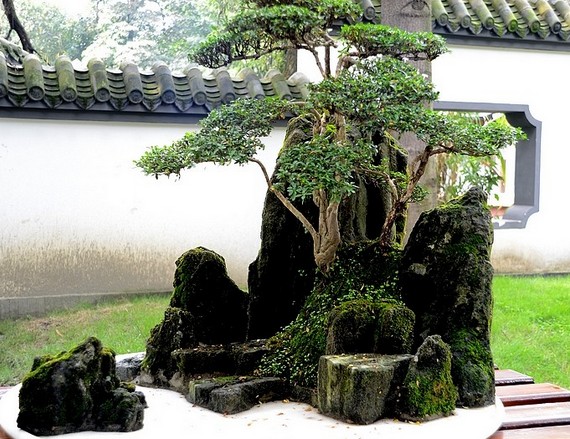
Sichuan-style bonsai has a long history, profound cultural heritage, and exquisite craftsmanship, with strong local characteristics. As early as the Shu Han period, the latter ruler Liu Shan built the Anle Palace in Chengdu, planting trees and grass in the palace gardens, recreating in pots and bowls the strange peaks and perilous cliffs, ancient trees and green pines from his memory. He also used stone and wooden boards to make pots and bowls of varying lengths, depths and sizes, planting dwarf trees and matching them with mountain stones, arranged in a "eight" shape in the palace gardens. Ministers and merchants followed suit one after another, and this form of landscape creation spread throughout Chengdu.
During the Tang Dynasty, Crown Prince Li Xian of Zhanghuai, who incurred the suspicion of Wu Zetian, was demoted to Chengdu. He spent his days in the company of flowers, plants and bonsai, making bonsai for pleasure. Murals of tree-and-stone bonsai still exist in the corridor of his tomb. In the late Tang period, during Li Deyu's tenure as military governor of Xichuan, he built the East Lake residence in Xinfan, Chengdu, where trees and stones complemented flowers and bonsai beautifully. In the Northern Song Dynasty, Du Wan in his "Yunlin Stone Manual" highly praised "Western Shu stones"... In the Southern Song Dynasty, Wang Shipeng wrote a poem "Jiannan Bonsai": "Both gentlemen have ancient hearts and lean, clear appearances, their interest lies in forests and springs, their zest is sparse. An inch of green has always been far from the Jin River, the Nine Peaks are divided toward the Western Mountain dwelling. The hills and valleys in the mountains are like the Golden Valley, the waves beneath the brush are humble compared to the Stone Canal. I have a thousand peaks hidden in Yandang, a pillar holding up the sky thrust into the void." The author's original preface: "Mr. Jinhua has a rare green stone, brought from afar from Chen Hongzhou of Shu... A family of Yandang peaks stands in jagged array, all objects among the desk and table." The author and the two friends who gifted him bonsai were all connoisseurs who deeply understood the pleasure of bonsai, and they praised highly the bonsai made from rare stones from the distant Jin River.
During the Ming and Qing dynasties, the body techniques and methods of trunk wiring and shaping in Sichuan-style bonsai had basically taken shape, and the annual Qingyang Palace flower and tree temple fair promoted the exchange and improvement of bonsai-making techniques. In the early years of the Republic of China, the wiring techniques were quite mature and complete, and the techniques of trunk bonsai were elevated to a historic height.