What are the characteristics of the Sichuan-style bonsai art style?
Sichuan-style bonsai, also known as Jiannan bonsai, is an outstanding traditional art of the Han ethnic group, a treasure among garden arts, a bonsai art school named after Sichuan Province, and one of the five major schools of Chinese bonsai. It is further divided into two local styles, western Sichuan and eastern Sichuan, and is known for being quaint and rigorous, gnarled and varied in form. Western Sichuan, with Chengdu as its center, includes such counties as Wenjiang, Pidu (formerly Pixian), Guanxian, Chongqing (formerly Chongqing County), Xindu, and Shifang. Eastern Sichuan, with Chongqing as its center, includes the counties surrounding Chongqing.
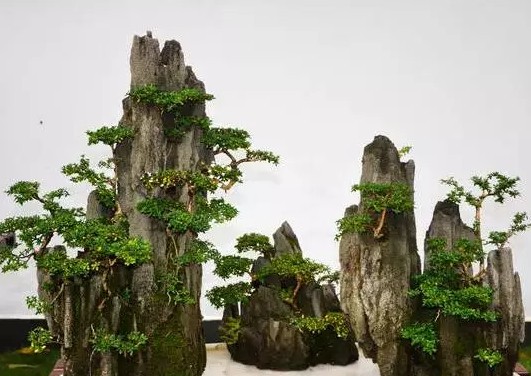
Sichuan-style bonsai art style:
Tree-stump bonsai is characterized by being quaint and rigorous, gnarled and varied in form; landscape bonsai wins by its majestic momentum. Height, suspension, steepness, and depth embody the typical features of the Bashan-Shushui (Sichuan Basin) landscape. Bonsai artists in Sichuan devoted themselves to understanding the Way and observed carefully, thus forming the unique modeling rules of Sichuan-style bonsai, which also made the craft of Sichuan-style bonsai making a national-level intangible cultural heritage.
Bonsai, this comprehensive art created by our ancestors out of reverence for nature and blending Chinese philosophy, calligraphy, and painting, carries the Chinese ideal of freely roaming among mountains and waters and embodies the tastes of Chinese literati. Wang Wei, Du Fu, Su Shi, Wang Shipeng, Lu You, and others all wrote poems and essays praising bonsai and took part in making bonsai, greatly enriching the cultural connotations of bonsai.
Chengdu has deep ties with the development of Chinese bonsai: Liu Shan, the later ruler of Shu during the Three Kingdoms period, and Li Xian, Crown Prince Zhanghuai of the Tang Dynasty, both made bonsai in Chengdu, driving the craft and artistic level of Chengdu bonsai. Sichuan-style bonsai, one of the five major schools in the country, is deeply rooted in the majestic and beautiful Bashan-Shushui, is the crystallization of the wisdom of the industrious Bashu people, and is an important part of Bashu culture.