Introduction to the Bonsai Garden of the Yangzhou-Style Bonsai Museum
The Bonsai Garden of the Yangzhou-Style Bonsai Museum is located in the Slender West Lake Scenic Area, integrating functions of collection, exhibition, popularization and research, covering an area of over 40 mu.
Yangzhou-style bonsai is one of the five major schools in China, and its craftsmanship of "one cun (one cun is 82.5px) with three bends" is truly unmatched in the world. In order to better protect this special bonsai-making technique, the Yangzhou Bonsai Museum has recently applied to the relevant authorities for national-level intangible cultural heritage status, and the application has been accepted. Yangzhou-style bonsai has a long history, and the key to its distinctive modeling - clearly layered, rigorous and balanced - lies in its exquisite pruning and binding techniques.
It is understood that Yangzhou-style bonsai, precisely by virtue of this rigorous craftsmanship, has repeatedly won gold and silver at national bonsai grand competitions, and in the early 1980s was designated as one of the five major bonsai schools in China.
"One cun with three bends" is based on the painting principle of Chinese painting that "no branch is straight within a cun," binding each branch in the cloud layers into fine serpentine curves, with the densest parts reaching 3 bends per cun, while the leaves remain arranged in parallel, like clusters of clouds, hence the name "one-cun-three-bend cloud-layer style." This is the most unique feature of Yangzhou-style bonsai. From the bonsai below, can you appreciate it?
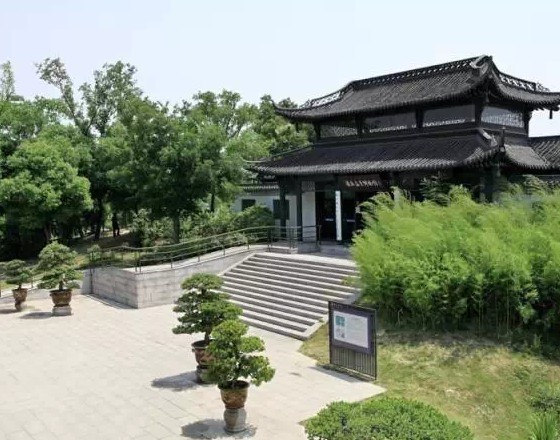
The Yangzhou-Style Bonsai Museum is located within the Ten Thousand Flowers Garden of Slender West Lake, surrounded by slopes and streams, with winding bridges, secluded pavilions, waterside verandas and long corridors stretching picturesquely into the scene, and lush flowers and trees offering scenery in all four seasons. It is a bonsai museum integrating functions of collection, exhibition, popularization and research.
The current collection totals more than 500 pieces, covering an area of over 40 mu, with a building area of more than 3,200 sq m and outdoor landscape walls of more than 300 m. The museum is divided into three parts: an indoor exhibition area, an outdoor exhibition area and a bonsai making and maintenance area, along with a demonstration performance hall, master studios, the Yangzhou Bonsai Research Institute and more.
Indoor Exhibition Hall
The history of bonsai is long and storied, originating earliest in China. Chinese bonsai "began in the Han and Jin dynasties, took shape in the Tang, developed in the Song and Yuan, flourished in the Ming and Qing, declined briefly in modern times, and is now reviving again." Yangzhou bonsai has developed almost in step with Chinese bonsai, and is a pioneer and important component of Chinese bonsai.
Outdoor Exhibition Hall
The artistic style of Yangzhou-style bonsai formed in the Ming Dynasty, matured in the Qing Dynasty, and gained fame in contemporary times. It benefits from Yangzhou culture and also integrates itself into Yangzhou culture. It blends "poetry, calligraphy, painting and technique" into one, becoming a unique elegant art, and can be called a representative work of Chinese bonsai art.
"Bonsai Painting" by Huang Shen, one of the Eight Eccentrics of Yangzhou
Yangzhou-style bonsai and Yangzhou gardens share the same lineage and have many common characteristics. They are both rooted in nature yet elevated above it, embodying the charm of poetry and painting and the resonance of artistic conception.
Yangzhou-style bonsai is closely related to the Yangzhou Painting School, and the two draw on each other with equally remarkable results. The calligraphy and painting theories and bonsai paintings of the Eight Eccentrics of Yangzhou provided aesthetic references for Yangzhou-style bonsai.
Yangzhou-style bonsai is a combination of art and technique, craftsmanship and culture. Its works embody the creator's aesthetic taste and reflections on life, and record the social atmosphere of a given period.
Work "Small Bridge, Flowing Water, Someone's Home"
Contemporary Yangzhou-style bonsai, while inheriting tradition, has shown a trend of diversified development. Many representative traditional-form bonsai and bonsai works innovated on the basis of tradition have won important awards at top international and domestic exhibitions.
"Lingering Charm of the Late Ming" by the Yangzhou-Style Bonsai Museum
It integrates Yangzhou's profound cultural heritage into bonsai that shrink the dragon to a cun, embodying the beauty of art, culture and inheritance. A classic couplet describes Yangzhou-style bonsai this way: "Winning more with less, jade herbs and rare flowers flourish through four seasons; viewing the great in the small, one glimpse reveals the fairy isles of Fangzhang and Penglai."