Historical Origins of the Formation of the Yangzhou-style Bonsai Art
The Yangzhou-style bonsai art took shape in the Ming Dynasty and matured in the Qing Dynasty. Drawing materials from nature and learning from the creator, it absorbed traditional Chinese humanistic values and aesthetic ideas, blending poetry, calligraphy, painting and technique into one. With a style that is delicate, elegant, graceful and expressive, and with the pruning and binding craft of “careful binding and fine pruning” and “one inch, three bends,” it carries on the lineage of Chinese bonsai art, standing alongside the Suzhou, Sichuan, Lingnan and Shanghai styles as one of the five major schools of Chinese bonsai art.
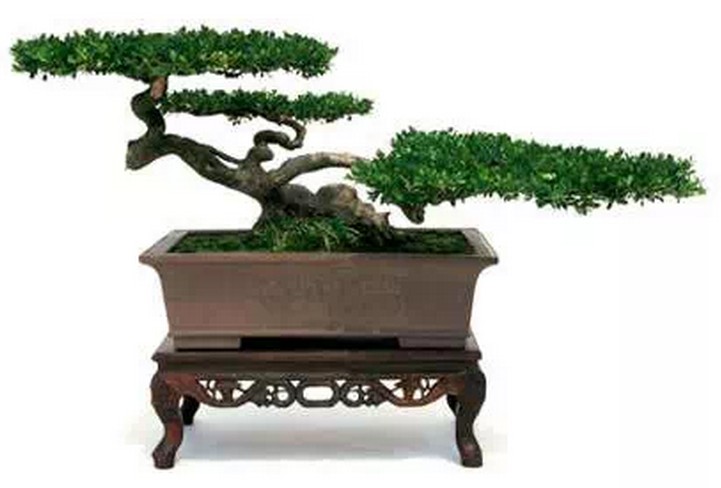
In the Yuan-dynasty poet Zhang Zhihan's poem "Thanking Tan Xuezheng for Sending a Potted Plum," there is the line “Last year in Yangzhou there were several plum trees, red and white, but only for a moment. Among them was one pot over six chi tall……” This is the earliest known record of a tree bonsai in Yangzhou. The artistic style of Yangzhou-style bonsai took shape in the Ming Dynasty. From surviving ancient cypress bonsai of the late Ming, one can glimpse the techniques of that time.
Li Dou's "Record of the Painted Boats of Yangzhou" has a line: “Every household has a garden, every home grows bonsai.” Yangzhou in the heyday of the Qianlong era, ah, it makes one's mouth water. Shen Fu, who also lived in the Qianlong heyday, wrote in plain description in Volume Two, "Leisure Notes on Idle Pleasures," of "Six Records of a Floating Life": “Again in a Yangzhou merchant's house I saw a visitor from Yushan carrying and presenting one pot each of boxwood and emerald cypress.” Bonsai had become an elegant gift.
The rapid development of Yangzhou bonsai in the Qing Dynasty had two important factors. First was the participation of men of letters, who not only loved bonsai but also made them with their own hands and composed many poems and paintings for them. Second was the involvement of the leisured class represented by Yangzhou salt merchants, who long employed full-time bonsai craftsmen to craft bonsai with fine workmanship, objectively driving the improvement of Yangzhou bonsai techniques.
Bonsai at the visual focal point of the inner gate of Yangzhou's Jixiao Mountain Villa
A case of indoor bonsai and furnishings in a Yangzhou garden home
The characteristic of Yangzhou bonsai is to see the great in the small, drawing on painting principles and learning from nature. Today, at the entrance of the Yangzhou-style Bonsai Museum there is a couplet: “Winning more with less, jade herbs and fairy flowers flourish through the four seasons; viewing the great in the small, a glimpse of the immortals' isles in a square zhang.” Though the couplet feels somewhat patched together, it still speaks the true essence of Yangzhou-style bonsai. Concentrating heaven and earth, mountains and rivers, trees, flowers and stones into a square-inch space, embodying poetic sentiment and painterly meaning, rooted in nature yet rising above nature, this is the essence of Yangzhou-style bonsai.