What are the finer points of the Yangzhou-style bonsai creation technique?
Yangzhou-style bonsai follows the Chinese painting principle that "no branch is straight for even an inch," using coir fiber for bending and shaping, and demanding precise tying and fine pruning. Every branch in the "cloud pads" is tied into very fine, dense serpentine curves; in the densest cases, each cun of branch can hold three bends, and every leaf lies flat yet facing upward, standing parallel, known as "three bends per cun." This technique is mainly used for the "cloud pad" shaping of species such as the Chinese boxwood (Buxus sinica). When wrapping and tying, one strives to "one knot per coir wrap, hiding both coir and knot." Generally the top pad is round, while the middle and lower pads are mostly palm-shaped. The number of "cloud pads" depends on the creative concept, the size of the plant, and the styling form; multiple layers are called the "skillful cloud" style. The smallest are like the mouth of a bowl, the largest like the mouth of a vat.
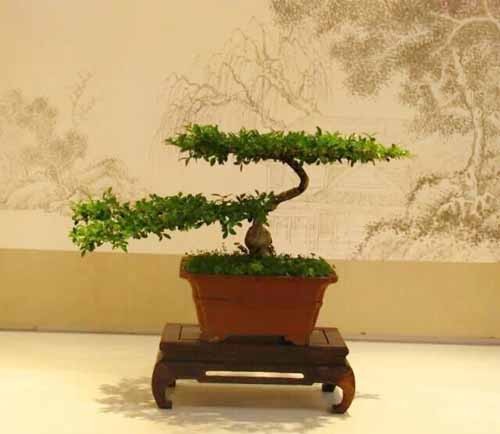
Coir tying methods:
The so-called coir method refers to the technique (handling method) of using the net-like fibrous scales on the trunk of the palm tree, combing out coarse, stiff individual coir fibers (coir filaments), twisting the fine, soft coir filaments by hand into coir threads of varying thickness, and then pruning and tying branches in different positions into shape according to the needs of the styling and pad formation. The basic coir methods of bending and shaping number 11: raised coir, bottom coir, flat coir, slanting coir, connected coir, leaning coir, waving coir, hanging coir, sleeved coir, mixed coir, and stitched coir.
There are 3 coir tying methods: single sleeve, double sleeve, and button sleeve. Single sleeve is mostly used on trunks with rough bark or scars, that is, positions where the coir filament (thread) will not slip off; double sleeve is mostly used on smooth, knot-free trunks, that is, positions where the coir filament (thread) easily slips off; button sleeve is mostly used for the first bend at the base of the main trunk, the part close to the soil surface.
There are two knotting methods: the slip knot and the firm knot. The slip knot is used when bending the trunk or branches: after tying the coir, first tie a slip knot at each bend to make it easy to adjust the tightness of each bend; once the trunk or branch has reached the ideal curvature, the slip knots are then tied into firm knots. The firm knot is used when no adjustment is needed after bending the branch into shape, so a firm knot is tied directly and the excess coir trimmed off on the spot.
Pruning and tying seasons:
Tree shaping (rough forming) and pad tying are generally carried out during the plant's dormant period (that is, from late November to late March of the following year), with the best season being before spring budding. Once the plant stops growing or the branches have become woody, re-padding can be carried out (after the cloud pads have taken shape, repeating the pad tying in alternate years is called re-padding).
Pruning and tying sequence:
Tree shaping generally proceeds from the base to the trunk, then to the top pad. For pad tying, the top pad comes first and the lower pads after; each pad proceeds from the main branch to the small branches and then to the twigs and leaves, so that every branch stands parallel in rows and every leaf lies flat yet facing upward.
Tree shaping:
The concept and layout are determined according to the size of the selected plant; the main trunk is shaped first, and then the cloud pads are determined according to the number of branches. There is no fixed rule for the number of cloud pads; 1-9 pads are all acceptable.
"Cloud pad" pruning and tying:
The individuality of Yangzhou-style bonsai lies in its "cloud pad" form; the layout of the "cloud pads" lies in the concept, and the realization of the concept lies in the tree, so when creating Yangzhou-style bonsai, the choice of tree is extremely important. The beauty of Yangzhou-style bonsai lies in its "cloud pads"; the beauty of the "cloud pads" lies in their uprightness, and the realization of that uprightness lies in the maker's skill, so when creating Yangzhou-style bonsai, besides having a fine concept, one should also possess the technical skill to apply the various coir methods.