What are the basic characteristics and main values of Suzhou-style bonsai?
Bonsai making in Suzhou has developed since the Ming Dynasty and gone through hundreds of years of vicissitudes. The most prominent feature of Suzhou-style bonsai's shaping techniques is the high degree of integration of art and science. It incorporates the theoretical foundations of literature and fine arts, takes the painting principles of the "Wu School" as the theoretical basis for creation, and especially, under the artistic influence of Wu culture, carries out shaping according to the growth habits of plants as a scientific basis, creates differently according to different plants, and at the same time, according to different prototype tree stumps, strives for the creative approach of "coming from nature yet surpassing nature", using the unique technical method of "coarse binding and fine pruning, with pruning as the main method and binding as the auxiliary", to create bonsai masterpieces in a thousand postures and a hundred forms.
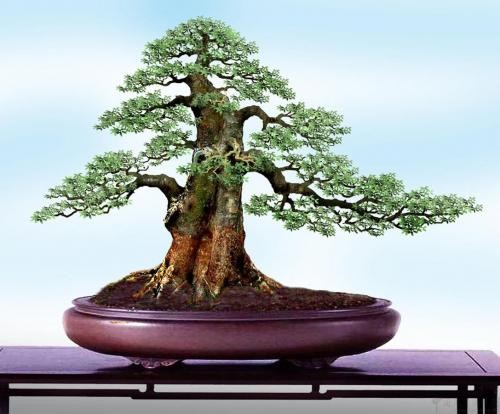
Suzhou-style bonsai shaping techniques also have permanence. Completing a bonsai work generally takes several years, and through scientific maintenance and management, its artistic cycle can last for decades or even hundreds of years, so it is also a cultural relic with vitality, worthy of being called a "living cultural relic".
Suzhou bonsai uses trees as its main creative material, and through artistic processing and careful cultivation, creates within a pot the beauty of imagery that comes from nature yet surpasses nature, and is popular throughout the world for its distinctive national characteristics and its elegant, refined, ancient and graceful artistic style. Its main values are:
1. Practical value
Suzhou is a garden city, and gardens large and small are miniature versions of nature, while bonsai works that come from nature yet surpass nature can better embody the art of garden-making. Therefore, if bonsai can enter thousands of households, what it brings people is an opportunity to get close to nature and appreciate art.
2. Horticultural value
The shaping techniques of Suzhou-style bonsai cannot be separated from careful maintenance and management. For existing bonsai works, in addition to using traditional techniques to ensure their growth, scientific maintenance techniques must also be used to manage them. At the same time, bonsai shaping techniques have an important guiding role for the shaping of landscape trees that are popular now.
3. Humanistic value
The works created by Suzhou-style bonsai shaping techniques all carry the creator's aesthetic tastes. Literati of past dynasties mostly used bonsai creation to express their own emotional world, to place their full enthusiasm and their reflections on the philosophy of life.
4. Artistic value
Suzhou-style bonsai shaping techniques are deeply influenced by the "Wu School" as well as by the influence of Wu culture. Especially by the 1950s and 1960s, Zhou Shoujuan and Zhu Zian combined the creative thinking of literati and horticulturists, organically unified bonsai creation techniques with the local painting style, and thus made Suzhou bonsai unique at home and abroad. Their works quite possess the posture of large trees in nature, majestic, rough and bold, and full of spirit. Their temperament is like the broad brushstrokes of a master of Chinese painting, with both spirit and form, where spiritual likeness surpasses formal likeness.
5. Historical value
The art of bonsai itself is the accumulation of history, reflecting the development history of bonsai in each period of past dynasties, and many existing works themselves are historical relics passed down to the present. In the creation process of Suzhou-style bonsai, ancient stumps, ancient pots and ancient stands are generally selected, so Suzhou bonsai works themselves are living cultural relics and have high cultural relic value.