Detailed Explanation of the Key Techniques of Su-style Bonsai Wiring
Suzhou bonsai traditionally uses palm fiber for wiring. Its advantage is that the color of the palm fiber harmonizes with the bark, and the wired stump has higher ornamental value. However, palm fiber wiring is quite difficult, and the skill level of the practitioner can be seen from the wiring technique. The main aspects to master are the anchoring points of the palm fiber and the appropriate thickness of the palm fiber. To meet the needs of rapid development today, the method now mainly uses aluminum wire for wiring, with palm fiber as a supplement, and its main techniques are the same as those for palm fiber.
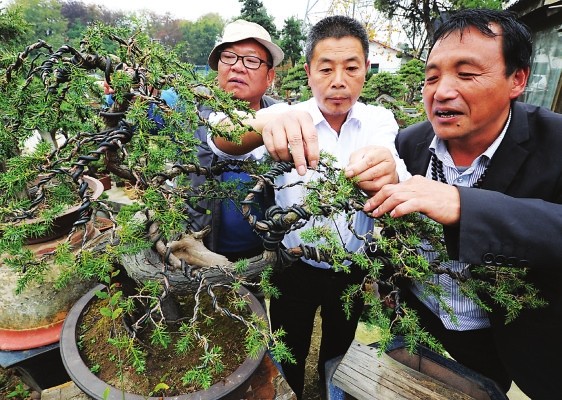
Because Su-style bonsai involves different tree species, their wiring techniques and pruning methods also differ. Old stumps generally have vigorous, ancient, and simple trunks with a natural posture and cannot be bent, so the branches only need to be slightly tied; this method is called the "half-wiring method." For bonsai cultivated and trained from seedlings, both the trunk and branches must be wired, which is called the "full-wiring method."
1. Full-wiring method
The material used is saplings, and everything from the trunk to the branches must be fully wired. The order of the full-wiring method is to wire the trunk first, then the branches and foliage. The trunk is wired from the lower part upward. Before wiring, the viewing side of the stump must first be determined, which bonsai experts call the "front." Then, according to the natural form of the stump, the bonsai style is determined. The styles of the full-wiring method include the coiled style, the lying-trunk style, the cliff style, and so on. Taking the coiled style as an example, the characteristic of this style is that the trunk forms an "S" shape, spiraling upward. When wiring, the front of the trunk faces forward. According to the size of the trunk, select an appropriate palm fiber and fix it at a suitable position on the lowest part of the trunk, preferably at a node or scar, so the palm fiber does not slip easily. Then twist the palm fiber left and right a few times, choose a suitable position on the upper part of the trunk and tie it off, and use scissors to cut off the excess palm fiber, thus completing the first curve of the trunk. The second and third curves are the key to wiring. The lower position of the second curve is generally about one-fifth upward from the middle of the first curve. After fixing the palm fiber, twist it left and right a few times, choose a suitable position on the upper part of the trunk and tie it off, and this completes the second curve. For the third curve, it is enough to wire upward along the "S" shape. Generally, after three curves, the top can be finished. After the trunk wiring is completed, the branches and foliage, also called leaves, can be wired. When wiring the foliage, first use palm fiber to fix the branch being wired to a slightly lower part of the trunk, twist the palm fiber left and right a few times, and use the right hand to bend the upward-growing branch down to a horizontal or slightly below-horizontal position. Then choose a suitable part of the branch and use palm fiber to fix it into a small curve, which is a half curve... Next, use palm fiber to pass through the half curve, twist it left and right a few times, and tie it off at a suitable part of the branch to form one curve; then follow this method to wire another curve forward to complete two and a half curves. The top foliage can generally be wired according to the coiling method for the trunk.
2. Half-wiring method
Most Suzhou bonsai are mainly made from dug-up wild stumps. For old stumps dug from wild hills, the trunk has already taken shape and cannot be bent for wiring. For such stumps, it is only necessary to determine the styling according to the natural posture of the trunk and wire only the branches and trunk, first wiring a half bend, then one bend, and then the second bend; there are "one and a half bends," "two and a half bends," and rarely "three and a half bends."