What are the stylistic characteristics of Suzhou bonsai?
Suzhou bonsai, commonly known as the Su style, is a type (school) of bonsai art style named after Suzhou. Centered on Suzhou, it spread to many areas south of the Yangtze River, such as Changshu, Wuxi and Changzhou. Its representative figures include Zhou Shoujuan and Zhu Zi'an.
Su-style bonsai is mainly tree bonsai. It emphasizes naturalness, with the form changing with the trunk, and seeks rapid formation, breaking free from the traditional shaping constraints of long formation periods, cumbersome procedures and rigid forms. Its artistic characteristics are elegant and refined, true and unadorned, vivid in spirit and charm, blending scene and feeling, and endlessly thought-provoking.
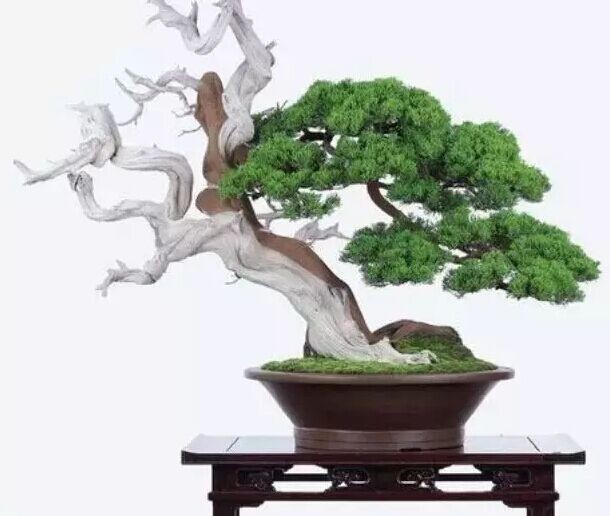
Traditional Suzhou bonsai were mostly formal styles, the most common being the "six platforms, three supports and one crown." Today, "semi-formal style" predominates, meaning the number of branch pads on the tree is unrestricted and the shape is formed into rounded pads, resembling a "steamed bun shape." The overall form is that of the old trees commonly seen in Jiangnan. Traditional forms of Suzhou bonsai also include screen style, windward style, weeping-branch style and split-trunk style. Su-style landscape bonsai mainly express the beautiful mountains and waters and the cultural relics and scenery of Jiangnan in our country. Su-style bonsai emphasizes the diversity and unity of the scene (trunk, stone), pot and stand. Especially when displayed and arranged in a hall, the scene, pot and stand must harmonize with the structure of the hall, and must reflect a well-matched and appropriate relationship between "scene" and "setting."
Stylistic characteristics:
1. Antique elegance
Dead trunks and old branches from trees decades or even centuries old are reduced to miniature scale and transplanted into a pot only a foot or so wide, appearing simple, unsophisticated and vigorous.
2. Fine craftsmanship, delicate and subtle
The second characteristic of Su-style bonsai is its fine craftsmanship and delicate subtlety, much like Jiangnan silk-and-bamboo music, giving people a feeling of elegance, beauty, brightness and smoothness. But its "fineness" is by no means intricate and cumbersome; rather, the refinement lies in the layout, conception and artistic mood, "embodying" the Chinese painting principle of "boldly laying down ink, carefully finishing up."
3. Deeply influenced by local gardens
The third characteristic of Su-style bonsai is that it is deeply influenced by classical Suzhou gardens. Some call Suzhou bonsai a condensed Suzhou garden. Suzhou bonsai can also be said to be a miniature version of a Suzhou garden.
4. Emphasis on artistic mood
The fourth characteristic of Su-style bonsai is its use of the principles of Chinese painting, its emphasis on artistic mood, and its focus on expressing the unity of object and self.
Antique elegance: dead trunks and old branches from trees decades or even centuries old are reduced to miniature scale and transplanted into a pot only a foot or so wide, appearing simple, unsophisticated and vigorous. For example, a pot of Chinese hackberry created by the old artisan Zhu Zi'an was praised by some as the "king of bonsai." This ancient Chinese hackberry is graceful in shape and peculiar in posture, with twisted thick branches exposed above the pot surface and thirty-seven leaves, standing gracefully like a canopy, lush green as if about to drip. It appears aged and unadorned, old yet all the more robust, and is also full of vitality, verdant and lovely.
Fine craftsmanship, delicate and subtle
● The second characteristic of Su-style bonsai is its fine craftsmanship and delicate subtlety, much like Jiangnan silk-and-bamboo music, giving people a feeling of elegance, beauty, brightness and smoothness. But its "fineness" is by no means intricate and cumbersome; rather, the refinement lies in the layout, conception and artistic mood, "embodying" the Chinese painting principle of "boldly laying down ink, carefully finishing up." For example, the small pot "A Single Branch Shows Elegance" created by Zhu Zi'an uses a tree stump with gnarled roots and twisted knots and, with a deft artistic technique, causes it to grow a single branch, so that the ancient stump and the new branch set each other off beautifully.
Deeply influenced by local gardens
● The third characteristic of Su-style bonsai is that it is deeply influenced by classical Suzhou gardens. Some call Suzhou bonsai a condensed Suzhou garden. The famous garden makers of Jiangnan included Zhang Nanyang and Ji Cheng in the Ming dynasty, and Zhang Lian and Shitao in the Qing dynasty, all of whom were skilled at both painting and garden making. Whenever a stone was chosen and placed upside down, it was invariably antique and refined, winding and picturesque. Therefore, to some extent, Suzhou gardens can be said to be the model for Suzhou bonsai, and conversely, Suzhou bonsai can also be said to be a miniature version of a Suzhou garden.
Emphasis on artistic mood
● The fourth characteristic of Su-style bonsai is its use of the principles of Chinese painting and its emphasis on artistic mood. For example, the water-and-stone bonsai "Leaning Against the Empty Stone Wall," created according to the poetic meaning of Wen Zhengming; the thousand-layer stone water-and-stone bonsai "Clouds Rise," pursuing the painterly meaning of Pan Tianshou; and the mixed planting of elm and mulberry "Herding Home as the Sun Sets Behind Mulberry and Elm" are all novel in conception and exquisite in design, taking nature as their method, profound in artistic mood, expressing emotion through scenery, and full of delightful charm.