A Detailed Explanation of the Traditional Craftsmanship and Characteristics of Suzhou-Style Penjing
Penjing craftsmanship refers to Suzhou-style penjing craftsmanship, which originated in the Tang Dynasty, flourished in the Ming Dynasty, matured in the Qing Dynasty, and developed in modern and contemporary times. Since the 1980s, Suzhou penjing has won major awards in exhibitions at home and abroad many times. In 2011, it was included in the third batch of the national intangible cultural heritage list.
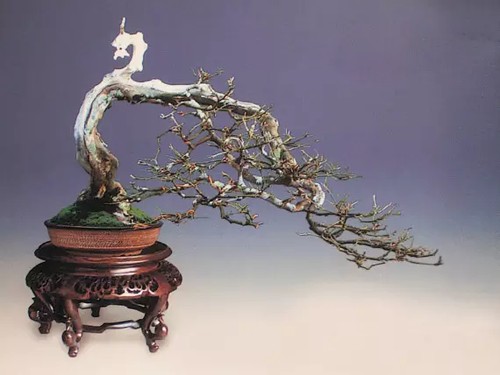
Penjing is created by growing plants in a container, accenting them with rocks, and combining these elements. Through the technique of expressing the large within the small, it conveys a mood of nature, and the changes of the four seasons can be seen in it.
Penjing craftsmanship is one of the time-honored traditional arts of the Han Chinese. Creating a penjing often takes years or even decades to complete. Creating a trunk specimen with both excellent form and spirit in a relatively short time is undoubtedly the wish of penjing enthusiasts and makers.
Craftsmanship mnemonic verses (partial):
1. Penjing is a wordless poem, a three-dimensional painting, a living sculpture.
2. The dragon emerges and disappears across thirty thousand qing, clouds and rain sweep across twelve peaks.
3. Fear not cutting the wrong branch; fear placing it in the wrong position.
4. A clear seat frees one from vulgarity; in leisure it summons cool breeze in summer.
5. On the day the scene is complete, the merit lies in ten years!
6. Straight long positions should be hidden rather than exposed; straight curved positions should be exposed rather than hidden.
7. Remove the strong and keep the weak; remove the coarse and keep the fine.
8. For plum blossom penjing, prefer breaking to bending, prefer slanting to straightness.
9. Rugao penjing: looking left and right, two and a half bends; cloud head, rain feet, beauty's waist.
10. Mountains and falling waters in the bleak night, drunk-dreaming of the rivers and lakes within a single leaf.
11. Do not water if not dry; when watering, it must soak through; see dry and see wet; apply thin fertilizer frequently.
12. Where sparse, a horse can pass; where dense, wind cannot penetrate.
13. No branch is straight for even a cun; one cun has three bends.
14. A landscape tree without roots is like a stuck-in wooden pavilion; observe the tip for a pavilion, observe the feet for penjing.
15. One branch shows twists and turns, two branches divide into long and short, three branches speak of gathering and scattering, many branches have both exposed and hidden parts.
16. Creation takes form with the wonder of a painting craftsman; the terrain within close range connects far into emptiness.
17. Examine accurately, cut ruthlessly.
18. In spring wipe out misplaced buds, in summer prune strong and weak branches; in autumn apply additional fertilizer, in winter prune the relevant branches.
19. Build up skills and truncate the trunk. Zhang mountain, chi tree, cun horse, fen person. Distant mountains have no trees; near is large and far is small.
Suzhou-style penjing emphasizes the creation of artistic mood, attracting people with the artistic charm of blending feeling and scene. It absorbs the essence of classical garden art, synthesizes the strengths of Chinese painting techniques, uses scenery to convey feeling and feeling to express scenery, and employs artistic methods such as “seeing the large within the small” to achieve the artistic effect of feeling within the scene and feeling beyond the scene. The works are thought-provoking and leave people reluctant to put them down.
Today, Suzhou-style penjing has successors, and the works are even richer and more varied. With the style of the new era, it will cultivate people's thoughts and sentiments, meet the people's cultural needs, and radiate a dazzling brilliance. Gardeners far and wide are working hard to create a new style of Suzhou-style penjing art.