Appreciation of Masterpieces of Suzhou-Style Penjing: Experience the Charm of Traditional Penjing Art
"Ancient Charm Abounds":
Species: Chinese sweet plum (Sageretia thea) Height: 57 cm Age: about 50 years
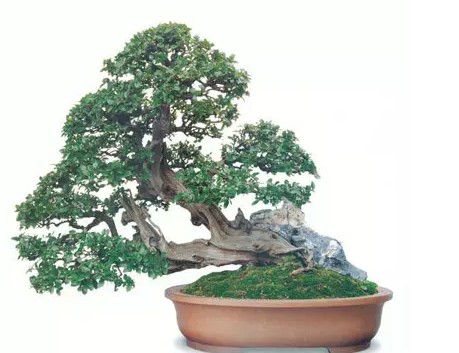
At first glance it looks like a completely withered old stump, and it has been shaped by human hands, yet it is quaint and natural; the dense canopy of branches and leaves makes it hard to believe that it grew from the back of this dead stump, yet this is an indisputable fact. The old stump is of the reclining type, with two trunks: one trunk lies horizontally along the stump body, extending out over the rim of the pot, while the other emerges at an angle and then rises; the stump form has great character. The author used the Lingnan school's branch-training technique, while the styling has the characteristics of Suzhou-style penjing, with a natural crown and branches like cloud clusters, giving a sense of layering. Both the stump form and the canopy lean toward the left side, yet there is no sign of imbalance. At the base of the stump a piece of landscape rock is placed, blending with the stump as one and also serving a balancing role.
"Grandeur and Elegance Made by Nature":
Species: Chinese elm (Ulmus parvifolia) Height: 80 cm Age: about 100 years
The base of the stump is massive in form and has an irregular cavity, displaying the many years of wind and rain it has weathered over more than a century; it is nature that created this marvelous stump specimen. The stump form is slanted, and above the cavity it divides into two trunks; following their form, the author styled both in the same slanted direction along the stump's momentum, giving it a rather handsome beauty. In the technique of styling, the author adopted the Lingnan branch-training technique and applied it within the art of Suzhou-style penjing styling, still achieving clearly defined layers and a natural crown, with a distinctive charm; it can be called a successful attempt. Looking at the whole, the stump body is quaint and magnificently strange, while the styling is natural and elegant.
"A Single Branch Displaying Elegance":
Species: Chinese elm (Ulmus parvifolia) Height: 78 cm Age: about 200 years
The stump body is simply a root crown, and it is already a hollow cavity, with the bark at the edges curling inward; this is the trace left from when it originally grew in a rock crevice with the tree body embedded in the mountain stone, while its root collar and root system are exposed above the soil surface, quaint and peculiar. A single main trunk, also the only branch and trunk, rises straight up from the rear part of the root crown, and its branch pad is also a single pad, with a canopy like an umbrella; the "apex" and the branch pad merge into one, standing tall like a canopy, yet it does not feel monotonous or dull, being concise and well-proportioned. The original author of this work is Zhu Zi'an, the main founder of Suzhou-style penjing; he styled according to the material, highlighting the ornamental part of the root collar. The large umbrella-shaped branch pad is actually composed of three to five small pads, which is the "scattered pads" technique often used by the author; the stump form and the styling blend appropriately and bring out the best in each other, making it a representative work of Suzhou penjing.
"Drunk on Jade, Fallen on the Mountain":
Elm. Gold Award at the 8th National Penjing Exhibition
This is a slanting, reclining elm penjing, with roots spreading out, relaxed yet powerful; the main trunk is vigorous and sturdy, with smooth lines; the branch pads are clearly layered yet remain natural. The creator put great effort into every part of the penjing, and the whole work is full of dynamism yet steady and elegant; wherever movement and stillness combine, it gives a sense of beauty. The artistic conception shown by the work fits its title "Drunk on Jade, Fallen on the Mountain" quite well: lying drunk yet not losing elegance, making it a rare fine penjing.
"Biluochun Spring Scenery":
Gold Award at the 2nd Yangtze River Delta Region Fine Penjing Exhibition
This is a highly distinctive penjing masterpiece that is unforgettable at a glance. The dense canopy and the broad root base at the bottom form a balance between top and bottom, making the work very steady. But the highlight lies in how the originally thick trunk, due to the appearance of a dead hollow and its nimble curves, creates a visual impact. Relying on the tension of the bark to support the tall canopy, it appears so elegant in addition to its strength, combining the beauty of both firmness and softness of Suzhou gardens, delighting the eye and the heart.
"Lingering Charm of Qin and Han":
Suzhou Zhu Zi'an Zhu Yongyuan
Species: Chinese juniper (Juniperus chinensis) Height: 170 cm Age: about 500 years
The stump body is slightly slanted and is only a remaining section of dead wood, aged and venerable, with the juniper's bones clanking; it is a true portrayal of its several hundred years of vicissitudes and wind and rain. On the right side of the stump, one line of "life branch" is its main trunk, rising along the stump, with three to five branch divisions twisting freely, the branch tips draped in green and hanging with emerald, scale leaves lush, full of vitality. At the stump base, a "later-born branch" lies horizontally, drifting slantingly outward to the right, merging into one; the overall styling is free and unrestrained, full of pictorial charm. This stump is quaint and magnificently strange, tall and graceful, with the momentum of Qin pines and Han junipers, and is praised as "living cultural relic," "three-dimensional painting," and "national-level penjing." It is planted in a large red-robed lotus pot made in the Ming Dynasty, matched with the "Nine Lions Pedestal," a relic from the residence of Zhang Shicheng's son-in-law in the late Yuan Dynasty, as the pot stand; the ancient stump, ancient pot, and ancient stand form a "trinity," making it a rare treasure of Chinese penjing art.
"Sound of Pines":
Species: Japanese black pine (Pinus thunbergii) Height: 50 cm Age: about 50 years
The trunk divides into two trunks at the root collar; the main trunk lies horizontally to the right and droops downward in a semi-cascade style, while the secondary trunk and one branch of the main trunk both grow upward; the bark shows cracking and peeling, the roots are raised, and claw-like roots are exposed, immediately giving an aged appearance. Following the semi-cascade form of the trunk, the author carried out wiring and shaping; the branches and trunk twist, the pine needles form clusters, the branches and leaves are evenly distributed, and the tree posture is full. The trunk form is aged and twisted, quaint, and the styling is natural and free; planting it in a hexagonal deep ladle-shaped pot better displays the loftiness and beauty of the tree posture, as well as the steepness and precipitousness of being at the cliff edge.
"Azure Clouds, Yellow Leaves":
Species: trident maple (Acer buergerianum) Height: 80 cm Age: about 160 years
The stump body is slightly slanted, seemingly a "great exposure" of the underground part of an old stump; three root veins extend into the soil, and one horizontal root (branch) connects with them, forming one hollow opening after another, and its shape is a bit strange. In terms of styling, the author took one main trunk on the left side of the stump body as the main subject. Through wiring and pruning, branch pads and layers were created, and the crown form is natural; the other secondary trunk, namely the horizontal root (branch) of the stump body, follows its horizontal branch pad and extends beyond the pot rim, reflecting the variation of the canopy width, handled just right. Its stump is quaint, elegant, and unadorned, and its form is natural and appropriate.
After trident maple is frosted in late autumn, its leaves turn yellow and then red; taking the meaning of the Song Dynasty famous minister Fan Zhongyan's ci poem "Su Mu Zhe" line "azure clouds in the sky, yellow leaves on the ground" as the scenic name, one can imagine the enchanting scenery of azure clouds and yellow leaves in autumn.
"Second Spring":
Species: small-leaved Chinese holly (Ilex cornuta) Height: 82 cm Age: about 80 years
The main trunk is slanted, then rises; the trunk body has a strong form; the root collar and its underground roots are exposed, clear and hollowed, and it can be regarded as the exposed-root style, undoubtedly adding an quaint charm to this stump. The author of this work was Zhou Shouhe; it was originally large-leaved Chinese holly, and after 1968 it was cared for and managed by his maternal grandson Li Weimin.
In the mid-1980s, Li Weimin used this stump as rootstock and adopted the high-branch multi-head grafting method to graft small-leaved Chinese holly scions onto it. After more than ten years of careful management and styling and pruning, it finally reached its present state. This work retains the characteristics of Zhou Shoujuan's original work, with branches and leaves evenly distributed, a natural and dignified canopy, and red fruits on the branch tips, making it even more lovely. The meaning of its scenic title is "Through wind and rain several springs still remain; the former master is succeeded by a worthy heir," which is extremely apt.
"Strange Branches Show Off Their Posture":
Species: Chinese juniper (Juniperus rigida) Height: 110 cm Age: about 200 years
The ancient, jagged, and peculiarly branched juniper stump has already become a "shari trunk," displaying the years and vicissitudes of history; its former majestic posture can still be vaguely recognized, but it has already become the past. However, it is precisely that line of "life branch" on the right side that extends from bottom to top along its dead trunk, and it is lush with branches and leaves; after the author's careful binding, the umbrella-shaped canopy stands tall like a canopy, standing atop the "shari trunk" and merging with it as one, like a withered tree meeting spring. That tall, resolute, naturally spreading, and vibrant tree posture, compared with the clanking-boned juniper stump, seems to be showing off its extraordinary bearing. And it is precisely this that turns decay into wonder, once again endowing the juniper with new artistic life and value.