The He Garden Yang-style Penjing Exhibition Is Here: The Perfect Time to Admire Red Leaves and Smell Osmanthus
Yang-style penjing were already being made during the Tang and Song dynasties. By the Qing dynasty, Yangzhou had built gardens extensively and penjing flourished, with the saying that “every household has a garden and every family grows penjing,” and a school was formed. In 1949, Yang-style penjing developed further. In early 1950, Yangzhou once sent 36 pine and cypress penjing to Zhongnanhai in Beijing. In 1973, Yang-style penjing, together with the Lingnan, Sichuan, Suzhou and Shanghai schools, was listed by the Landscape Greening Bureau of the State Administration of Urban Construction as one of the five major schools of tree-stump penjing in the country.
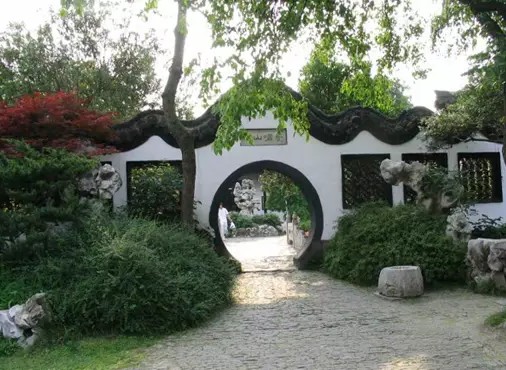
Yang-style penjing are exquisitely crafted, and are especially distinctive for their foliage-type pines, cypresses, elms and poplars (boxwood, also known as Chinese littleleaf box), with local characteristics of clear layering, strict balance and a decorative beauty rich in fine brushwork, and with Han Chinese cultural charm, winning fame at home and abroad. The penjing exhibited this time at He Garden are mainly based on the Eight Scenes of the Yang style.
Admire the red leaves and smell the osmanthus!
“In October the frost-kissed leaves are red as fire.” During the National Day period, the red maples at He Garden bloom one after another. When you come to He Garden to admire the red leaves, picking up a fallen leaf in your hand will have its own unique beauty! Walking into He Garden, you can see osmanthus covering the branches, with wave after wave of delicate fragrance rushing toward you, making you feel relaxed and happy.
Introduction to He Garden:
He Garden is located at No. 66 Xuningmen Street in Yangzhou, Jiangsu Province. It is a Major Historical and Cultural Site Protected at the National Level and one of the first 20 key parks in the country. He Garden is also known as “Jixiao Mountain Villa” and was built by He Zhidao during the Guangxu period of the Qing dynasty. The original site of He Garden was an ancient garden from the Qianlong period named Shuanghuai Garden. Famous people who once lived at He Garden include: the famous master of traditional Chinese painting Huang Binhong, who came to Yangzhou six times and stayed on the first floor east of the Qima Building; and the famous writer Mr. Zhu Qianhua, who once lived at He Garden for more than five years, with his former residence on the second floor east of the Qima Building.
The main feature of He Garden is that it brings the function and charm of corridor architecture to the extreme: the 1500 m double-path winding corridor. He Garden tourist attractions, the He Garden scenic area, is a splendid landscape unmatched among Chinese gardens. With left and right branching, high and low interlinking, embracing mountains and encircling water, and leading from hall to inner rooms, it forms an all-round three-dimensional landscape and an all-weather touring space, fully expressing the beauty of looping change and the wonder of extending in all directions in Chinese garden art, and is praised as the prototype of a cloverleaf interchange. In 1988, together with Ge Garden, it was awarded by the State Council as a third-batch “Major Historical and Cultural Site Protected at the National Level.”
He Garden is praised as the “No. 1 Garden of the Late Qing Dynasty.” Among its features, the Pian Shi Shan Fang is a rockery work by Master Shitao and can be called a solitary masterpiece in the world.