Detailed Explanation of the Unique Styling Structure of Suzhou-Style Penjing
Suzhou is situated on the shore of Taihu Lake, with clear waters and verdant hills, picturesque scenery, a humid climate and abundant rainfall. The variety of plants available here for making penjing is extremely rich. Suzhou also abounds in various rocks suitable for landscape penjing, such as the exquisitely intricate Taihu stone, Kunshan white stone, Suzhou yellow stone and so on. This provides ample material conditions for penjing making. Suzhou, a city founded 2,500 years ago, was also historically a place where talent gathered and culture flourished, a region renowned nationwide for poetry, calligraphy and painting. Wei Yingwu, Bai Juyi, Liu Yuxi and others of the Tang Dynasty all once served as governor of Suzhou. After the Song and Yuan dynasties, the number of men of letters who came from Suzhou or once lived there grew even greater, leaving behind many poems, essays and paintings for Suzhou. Since penjing is an art form steeped in poetic and painterly charm, these poems, essays and paintings became the source of creative inspiration for penjing artists.
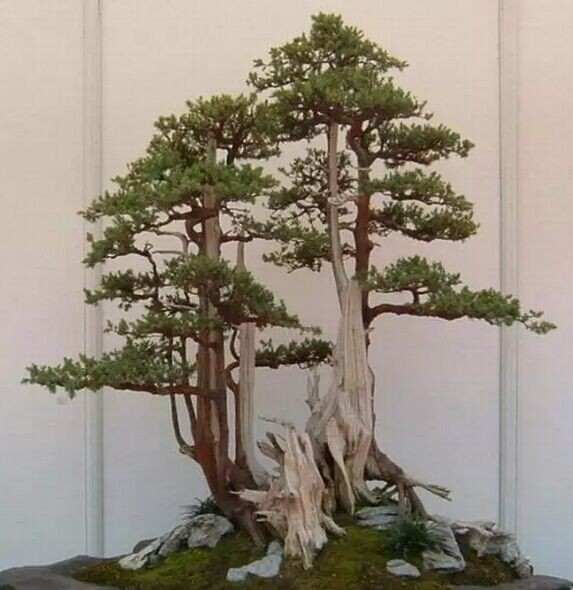
The development of Suzhou-style penjing art was uniquely favored by nature. Taihu stones are exquisite and intricate, and fine trees could be found at will along mountain cliffs and streamsides. Suzhou's landscapes are beautiful and its scenery delightful; historically there were already many master garden-makers who captured the rustic charm of mountains and forests within the art of urban gardens, and thus the penjing art of "a thousand miles within a foot, a dragon compressed into an inch" gained models to learn from; moreover, Suzhou has long been a place where men of letters gather, and penjing art, steeped over time in their culture and art, gradually formed the regional character and unique traditional style of Suzhou-style penjing art.
Suzhou-style penjing is known for its antique elegance and rustic simplicity. Gnarled old branches decades or even a century old, cultivated in small pots, can remain less than a foot tall while naturally forming their shape, whether hanging or trailing, bending down or leaning up; paired with antique pots and Suzhou-style stands, they are brimming with antique charm.
The compositional conception of Suzhou-style penjing is meticulous and refined, modeled on nature and blending with the natural, with scarcely any trace of the chisel, rich in artistic appeal. In handling relationships such as emptiness and solidity, curvature and straightness, sparseness and density, opening and closing, light and shade, the veins and logic are clear and the craftsmanship outstanding.
Suzhou-style penjing emphasizes the creation of artistic conception, attracting people with the artistic charm of blending feeling and scene. It absorbs the essence of classical garden art and synthesizes the strengths of Chinese painting techniques, using scenery to convey feeling and feeling to express scenery, employing artistic methods such as "seeing the great in the small" to achieve the artistic effect of feeling within the scene and feeling beyond the scene as well; the works are thought-provoking and people cannot bear to put them down.
Today, Suzhou-style penjing has successors and its works are even richer and more varied. With the bearing of a new era, it will cultivate people's thoughts and sentiments, satisfy the people's needs for cultural life, and radiate a dazzling brilliance. The broad ranks of horticultural workers are striving to create a new style of Suzhou-style penjing art.
Among those who most influenced Suzhou penjing style were the four great painters Shen Shitian, Wen Zhengming, Tang Bohu and Qiu Shizhou of the Chenghua and Hongzhi periods of the Ming Dynasty, later known as the "Wumen Painting School." Among men of letters of successive dynasties in Suzhou who made penjing themselves were Fan Chengda in the Song, Wen Zhenheng in the Ming, Hu Huanzhang in the Qing, and Zhou Shoujuan in modern times; Mr. Zhou once said: "My penjing, on the one hand, are original creations of my own, and on the other hand, are made in imitation of famous paintings of the ancients." He once made penjing imitating Tang Bohu's "Banana and Rock" of the Ming Dynasty, Xia Zhongzhao's "Bamboo Charm" and "Half-Window Clear Green," and Wang Yanke's "New Calamus and Longevity Rock" of the Qing Dynasty, among others. Suzhou-style penjing is mainly tree-stump penjing, and the materials used can be divided into two major categories: one is deciduous tree species, the other is evergreen tree species. Among deciduous species, those mainly for viewing flowers and fruit include winter jasmine, crabapple, pomegranate, plum blossom, wisteria and so on; those mainly for viewing roots, branches and leaves include elm, trident maple, red maple, Japanese apricot, boxwood and so on. Among evergreen trees, those mainly for viewing flowers and fruit include camellia, azalea, tiger thorn, gardenia, nandina, Chinese holly, osmanthus and so on, as well as those for viewing roots, branches and leaves such as black pine, five-needle pine, podocarpus, creeping juniper, true cypress, Chinese juniper, bamboos, small-leaved holly and so on.
Before the founding of New China, Suzhou penjing making had many rigid rules and taboos; each tree often had to be trained into "six platforms, three supports and one crown," ten pads in all, before it could be called penjing. This meant leaving three side branches on each of the left, right and rear sides of the trunk, and when they slowly grew, training three pads on each of the left and right sides, namely the "six," then training three more pads at the rear, namely the "three supports"; finally the top was trained into one pad, namely the "one crown." All ten pads were trained with palm fiber into round pad shapes, requiring more than ten years; it was not only labor-consuming and time-wasting but also excessively artificial, losing naturalness.
In the late 1950s, Zhou Shoujuan and the old craftsmen Zhu Zi'an, Zhang Shijin and others advocated that penjing should be based mainly on natural beauty and opposed contrived artificiality. Before the trees sprouted in early spring, they collected old tree stumps from the mountain forests on the outskirts, planted them in pots, placed them in sunny, wind-sheltered spots or greenhouses, maintained a certain humidity, and after they sprouted and grew branches, pruned and trained them as they went, so that they took shape by early autumn. This was the rapid cultivation method they created: dug that year, cultivated that year, pruned and trained into shape that year, and enjoyed that year. Penjing made by this cultivation method took various forms and were richer in natural beauty. At the same time, in technique they pioneered the precedent of giving priority to pruning with training as a supplement, changing the previous method of giving priority to training with pruning as a supplement; this relatively advanced method of coarse training and fine pruning won deep praise from experts across the country. At that time, 22 large and medium-sized cities including Beijing, Tianjin, Jinan, Yantai, Qingdao, Lanzhou, Xi'an, Lintong, Wuhu, Hefei, Guilin and Jingdezhen sent horticultural workers to gather at the Suzhou Municipal Garden Management Office to study the "rapid penjing cultivation method."
At the 6th China Penjing Exhibition held in Quanzhou, Fujian, Suzhou-style penjing once again returned with honors, achieving an excellent result of one gold, three silver and three bronze. However, while penjing skills continued to improve, Suzhou, as one of the birthplaces, saw penjing grow further and further away from the general public, and the penjing market remained sluggish.