Detailed Tutorial on How to Create Shanghai-Style Bonsai
Everyone knows that if we want to do anything well, we cannot act blindly; we must think it through carefully before proceeding, so that we can achieve twice the result with half the effort. Otherwise, haste makes waste. Take bonsai creation, for example. To create a successful and satisfying work, besides doing the preparatory work in advance, we also need to proceed steadily and step by step. This is because bonsai creation is very meticulous work that consumes a great deal of time and energy.
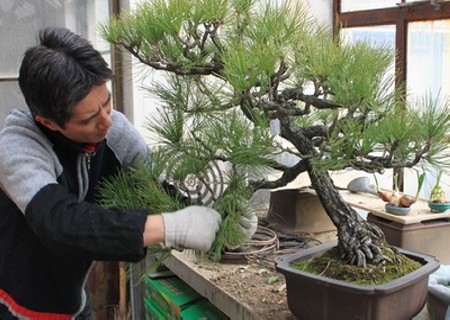
Now let us take making Shanghai-style bonsai as an example. Making Shanghai-style bonsai is the same as making other bonsai: the first thing to do is to prepare a full set of specialized tools, then carry out conceptual design and draw a mature preliminary sketch or even a finished-effect drawing of the work, and only then can creation proceed according to the drawn effect drawing. So, how do you make a Shanghai-style bonsai? Below, the editor will explain the method of making Shanghai-style bonsai. Although the steps are simple, the meaning is profound, so enjoy savoring it!
I. Preparing Tools
To create different bonsai works, we need to choose different specialized tools. Since what the editor is discussing today is making Shanghai-style bonsai, the tools chosen are naturally suited to the Shanghai style. So what tools do we need? Of course, the more abundant the tools we prepare, the better. The main ones are:
Hand picks, screwdrivers, awls, woodworking saws, various types of scissors (flat-mouth shears, curved-mouth shears, branch shears, etc.), electric grinders, small electric hand planes, brushes, and other supplies. In short, every tool that might be used should be available in full.
II. Drawing and Composition
There are abundant tree species in nature, each with its own characteristics. After selecting a suitable tree species for making bonsai, we need to carry out bonsai creation on this tree. But before creating, in order to make the process more calm and smooth, we should first draw and compose according to our creative ideas.
How exactly should we compose? Since tree forms in nature are extremely varied, we can neither copy them uniformly nor improve them drastically. Reasonable composition needs to reflect the author's creative ideas, the techniques used, and the presentation form of the bonsai all through the composition.
Usually, we need to conduct an artistic review in combination with the variously shaped tree forms in nature, abstract and conceptualize the concrete physical object, and then, based on our own practical creative experience, complete it by choosing creative techniques that are as scientific, reasonable, and aesthetically pleasing as possible. It should be especially pointed out that creation cannot break the growth laws of trees in nature; it should reflect the original natural attributes as much as possible.
Next, a comprehensive assessment of the tree species is also needed, achieving the transformation of the physical object from abstraction to figurative thinking. This process is the evolutionary process from physical object to abstraction to image to physical object.
III. The Production Process
The production process of Shanghai-style bonsai is mainly the process of shaping. In this process, the creator is required to skillfully use various techniques, know the shaping of every part of the tree like the back of their hand, and be able to conjure the effect drawing of the creation in their mind at any time. The creation of Shanghai-style bonsai mainly includes the following aspects:
1) The role of the root system
The root system of a tree can not only display ornamental value but also signify a breath of life. Therefore, in shaping the tree's root system, these two roles must never be neglected.
2) Shaping the trunk
The shaping of the trunk of a Shanghai-style bonsai determines the form and direction of the bonsai as a whole. During shaping, we need to draw more on the external expressions of those beautiful tree species in nature. Of course, this also needs to be completed in combination with the characteristics and growth habits of the tree species itself. Never force it to be shaped according to a fixed idea, otherwise it is easy to harm the tree and even alter the laws suitable for its growth.
3) Shaping the branches and leaves
The quality of a tree's branch and leaf shaping directly determines the artistic effect of the bonsai. To let it bring out its own graceful and varied characteristics, it should be unique in form so that its charm stands out. Only when the branches and leaves are shaped properly can they play a crucial embellishing role for the entire bonsai and reflect texture and beauty.
In the creation of Shanghai-style bonsai, besides the grooming of the root system, we also need to pay attention to the pruning of every part, making it as scientific, reasonable, and just right as possible. For the interweaving and display of branches and trunks and the transitions between curves and straightness, all should be handled flexibly according to the size and thickness of the branches, so that neither their natural growth laws are changed nor their own artistic value is affected.