A detailed explanation of the Lingnan bonsai crown-finishing branch method, mastering the key points of tree crown shaping
For the crown finishing of a stump bonsai, the traditional “left-right-left” method can be changed to a spiraling crown finish. This keeps the crown low yet still allows for a rich tree form, giving the bonsai plant a wonderful effect of a thick but low trunk in a specific natural environment. At the same time, it also gives people a fresh, simple and natural feeling.
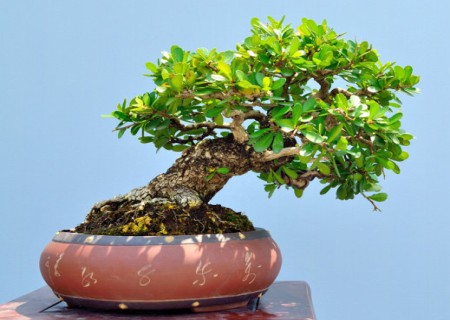
Lingnan bonsai requires the overall tree form to be graceful and harmonious, and there is a strict set of rules for every shaping step. Especially at the crown-finishing stage, in addition to satisfying the artistic effect, it must also particularly reflect a natural feel, so that its form and connotation achieve perfect unity.
However, in practice it has been found that once the branch pads grow too quickly, the upper part of the tree becomes unusually bulky after crown finishing, because compared with other parts, the plant grows fastest in the crown area. Only by reducing the bulky branch pads as much as possible to an appropriate proportion will the crown appear well-formed and elegant.
As for how a tree should be crown-finished, it is recommended to keep 3-5 side branches on the top branch for crown finishing, and keep several branches below it to extend in all directions. This process needs to be arranged and retained one by one according to the thickness and length of the branches, avoiding overlapping branches. This not only provides very good openness but also a very strong sense of layering, and is very vivid.
Of course, in order to achieve a heightened effect, during the process it is necessary to ensure that the branches have variation, not rigidly following one branch extending all the way to the end. It should show the effect of bends and nodes, and display the effect of horizontal angled branches. Only the top created in this way can be called perfect.
However, in order to present Lingnan stump bonsai with a powerful artistic effect, we need to control it as a whole, consider both the upper and lower parts comprehensively, make reasonable choices, and shape it scientifically. The upper part mainly refers to the crown-finishing process of the tree crown, and the lower part mainly refers to properly handling the root base. Only when the shaping is handled well as a whole can it become an excellent bonsai masterpiece.