Lingnan Penjing Trunk Chopping and Branch Cultivation Techniques and Branch Direction Handling Methods
The creation of Lingnan penjing has always emphasized the direction of branches. Whether a perfect Lingnan penjing work can be created mainly depends on whether trunk chopping and branch cultivation are done properly, as is widely known. The direction of penjing plant branches is directly related to the overall layout of the work and its mutually reinforcing effect.
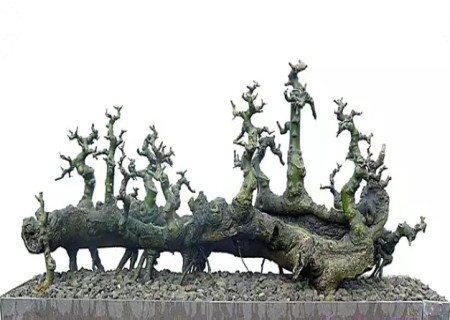
Trunk chopping is a relative concept. It does not mean cutting off the main trunk of the plant, but rather cutting away branches on the main trunk that affect the beauty of the shape. Through repeated trunk chopping, the purpose of branch cultivation can be achieved. Of course, this also requires deciding whether trunk chopping is needed based on the overall layout of the branches.
If trunk chopping is not carried out and those branches are allowed to grow freely, while the focus is placed on shaping through stretching and wiring, the branches will quickly show signs of aging, or even lose their lower branches. Moreover, stretching and wiring can damage subcutaneous bud positions, and can even cause some tree species to never sprout again, with serious consequences.
In addition, to achieve a good layout for Lingnan penjing, the direction of the branches is especially important. In particular, the starting point of the branch supports and the angle at which branches sprout must be well controlled. Branches used for penjing shaping are usually required to be greater than 45°. This requires handling by means of angle alignment, that is, manually bending non-aged branches with wire.
Of course, during the shaping process we also need to grasp the structure of the branches, namely the main branches and side branches. The main branches in particular need to achieve an effect of undulation and prominence, with a very strong sense of rhythm; while side branches mostly express themselves in a soft and graceful linear form.
An excellent shaping effect cannot be achieved without developing the key branches and important branches, mostly through a combination of floating branches, probing branches, dragging branches, dropping branches, pouring branches, and so on. Here, the editor will briefly introduce these concepts:
1. Floating branch: the main branch drifts slightly downward while remaining parallel, in order to make the branch appear more perfect and rhythmic.
2. Probing branch: this has similarities to the floating branch, but its greatest feature is that it stands out strikingly among many shaped branches and is unique.
3. Dragging branch: mostly used in slanting-trunk penjing shapes, with the effect of breaking the rear and pressing the foot.
4. Dropping branch: that is, during the extension of the main branch there is suddenly a strong effect of bending and dropping, often seen in tall tree forms.
5. Pouring branch: as the name suggests, once the main branch grows out it immediately bends downward and presents a pouring state, giving people a vigorous and powerful effect.
In short, in the shaping of Lingnan penjing, in order to present it in its most beautiful posture, attention must be paid to the direction of the branches. If the direction of the branches is handled well, naturally everyone is happy; otherwise, the hardships of creation will turn into regret.