What are the rules for branch direction in Lingnan bonsai?
Lingnan bonsai has always placed great emphasis on the skill of the branch pads and their direction. Whether the work shows enough skill depends on whether your branch pads have been developed through the trunk-chopping and branch-cultivating method, and this is certain and beyond dispute. The direction of the branch pads is directly related to the overall layout, and the two complement each other. Trunk chopping is relative; it does not mean that chopping off the main trunk is trunk chopping. Rather, cutting back the trunk on the main branch pad is also trunk chopping (the requirement for a tree on a tree), and repeated trunk chopping achieves the purpose of cultivating branches. Of course, it cannot be separated from the requirements of the overall layout. Otherwise, if the tree is allowed to grow leggy and the emphasis is placed on wiring and shaping, the branches will quickly age and the lower legs will drop. Focusing on wiring will damage the cortex and bud positions, especially in pines, which will never sprout again. (Note: this is a flaw, but it is not an inevitable result.)
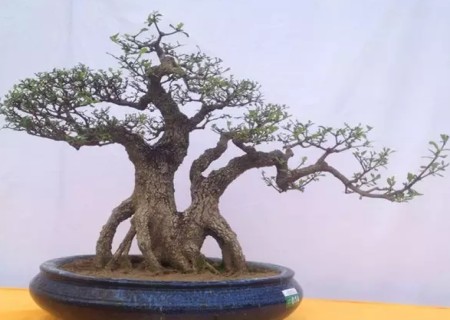
But if cloud-pad form is required, this does not apply, because it does not need branch cultivation; achieving its form is its composition. Without branch cultivation, growth is fast and resistance is strong, though maintaining the shape is somewhat harder. Please look at the trunk-chopping and branch-cultivating example in the picture below, and comments are welcome.
As is well known, the artistic shaping of Lingnan bonsai is based on the trunk-chopping and branch-cultivating method, and does not use wiring for composition and shaping. This is related to the warm, humid climate and abundant rainfall in the south, where plants grow quickly. The trunk-chopping and branch-cultivating method has become a unique method of bonsai artistic shaping and has been widely accepted by bonsai enthusiasts around the world.
1. The shaping technique is old-fashioned
This shape is one that Lingnan bonsai has continued to use to this day: a formal, standard, high-position double-trunk natural large-tree style. It is not that it is bad, but that it is too ordinary and lacks innovation in style. Having seen it too often, the impression is instead not deep, as in the picture below:
2. Improper handling of the trunk-chopping and branch-cultivating method
The trunk-chopping and branch-cultivating method is the basic principle of Lingnan bonsai shaping. Why is it handled improperly? We must start from understanding "trunk chopping" and "branch cultivating." Trunk chopping means not allowing the trunk to grow leggy, so that height and lowness, length and shortness conform to proportional requirements. Branch cultivating: "cultivating" has the meaning of storing. Its main purpose is not breaking and cutting off; rather, by repeatedly breaking and cutting branch pads, the sap and nutrients of a certain part of the branch pad are blocked, the tissue cortex proliferates and accumulates, swells and enlarges, thereby achieving the purpose of "branch cultivating," according to the proportional requirements of the trunk diameter. The impropriety mentioned here is that it has gone too far, causing disproportion: the branch pads are too large, bloated, and lose their elegant, eye-catching feel. Cantonese people call this "fat boy branches," as in the picture below:
3. Analysis of the application of the trunk-chopping and branch-cultivating method
The northern weather is cold and plants grow slowly, while the south is humid and warm and growth is fast. Even within the Lingnan region, different plant species grow at different speeds. With different sizes of raw trunk material, the growth speed of the branch pads also differs greatly.
1) "Climbing Cloud" is a small-to-medium bonsai, a high-position double-trunk natural large-tree style. The red fruit is an imported South American tree species, grown in Lingnan, vigorous and fast-growing. Because the raw trunk material is small and fine, using the trunk-chopping and branch-cultivating method to develop branch pads is relatively easy, and if not controlled well it is easy to go too far, causing the branch claws to become too large and disproportionate.
2) Control the branch pads from growing too fast; the crown is especially prone to becoming bloated and enlarged, because the growth points at the top of the plant grow fastest, as in the picture below. The bloated and enlarged branch pads have already been reduced to meet proportional requirements, making it look somewhat more delicate and elegant.
3) Judging from the overall structure, the main problem lies in the proportion between the trunk and the branch pads, which affects the artistic effect of the tree's appearance. The picture below is an ideally revised draft, more free and elegant, clearer and more refined.