What are the production techniques of Sichuan-style bonsai? A detailed explanation
Sichuan-style bonsai is one of the five major traditional bonsai schools in China, deeply rooted in the majestic and beautiful landscapes of Sichuan. The bonsai production techniques represented by the Chengdu area are the foundation and core of Sichuan-style bonsai production techniques. Bonsai artists of Sichuan devote themselves to understanding the way and carefully observe, and their production techniques have thus formed the unique modeling rules and techniques of Sichuan-style bonsai, distinguished from other schools by their distinctive techniques and artistic characteristics.
Sichuan-style bonsai, also known as Jiannan bonsai, originated in Shouan Town, Wenjiang District, present-day Chengdu. It is an outstanding traditional art of the Han ethnic group and a treasure among garden arts. It is a bonsai art school named after Sichuan Province and is also one of the five major bonsai schools in China. It is further divided into two local styles, western Sichuan and eastern Sichuan, known for being simple and rigorous, gnarled and varied in form. Western Sichuan is centered on Chengdu and includes Wenjiang, Pixian, Guanxian, Chongqing, Xindu, Shifang and other counties. Eastern Sichuan is centered on Chongqing and includes the counties surrounding Chongqing.
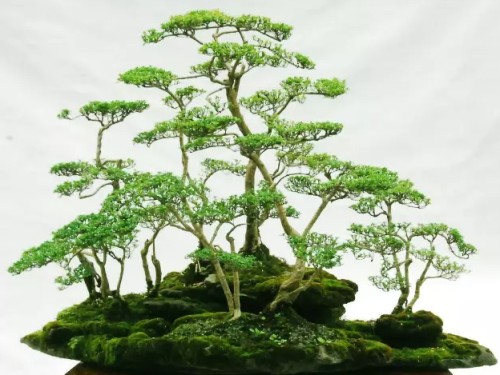
Sichuan-style bonsai has a long history, profound cultural heritage, exquisite production techniques and rich local characteristics. As early as the Shu Han period, Liu Shan, the later ruler, built the Anle Palace in Chengdu, planting trees and grass in the palace gardens, reproducing in pots and bowls the strange peaks and perilous cliffs, ancient trees and green pines of his memory. Stone materials and wooden boards were also used to make pots and bowls of varying lengths and depths, planted with dwarf trees and matched with mountain stones, arranged in a "V" shape in the palace gardens. Ministers and merchants followed suit one after another, and this form of landscape creation spread throughout Chengdu.
Sichuan-style bonsai has developed to the present with two forms: formal style and natural style, with the formal style being dominant. The formal style emphasizes "body method," that is, the modeling method of binding and bending the trunk. The natural style is mostly set according to the tree stump itself, with no specific fixed method, including multi-trunk and single-trunk tree stumps, reclining tree stumps, slanting-drift tree stumps, small and large cliff-style tree stumps, and so on, with different forms, shaped according to the tree.
The representative tree species of Sichuan-style bonsai include golden bullet tree (Diospyros cathayensis), serissa (Serissa japonica), Chaenomeles speciosa, Malus halliana, plum blossom, crape myrtle, Buddhist pine (Podocarpus macrophyllus), ginkgo, and Chinese juniper (Juniperus chinensis), among others. There are also tiger thorn (Damnacanthus indicus), Ficus virens, redbud (Cercis chinensis), camellia, osmanthus, and so on. There are many varieties of bamboo, including Mian bamboo, Qiong bamboo, phoenix-tail bamboo, Guanyin bamboo, Qinsi bamboo and Buddha-belly bamboo.
The modeling of Sichuan-style bonsai has two forms: formal style and natural style. The formal style is dominant, because it is the representative of Sichuan-style bonsai art. The formal style emphasizes "body method." The so-called "body method" is the modeling method of binding and bending the trunk, and it is the main feature of Sichuan-style bonsai art. Like Yangzhou-style bonsai, it is cultivated from a young age and excels in binding and bending techniques, expressing the rigorous and extraordinarily majestic style of Sichuan-style bonsai. In Sichuan-style bonsai, different models have different "body methods." The formal-style trunk has ten forms of expression (body methods).
The formal-style stump scenery of Sichuan follows its traditional binding and bending techniques for modeling, with certain rules and numerous names too many to enumerate. Their trunks and side branches are bent from a young age with palm fiber in various angles and directions according to different formats, emphasizing three-dimensional spatial composition, which is relatively difficult. The trunk forms roughly include "rolling dragon embracing pillar," "opposite bend," "square bend," "dropped bend," "three bends and nine reverse bends," "large bend with drooping branches," "straight body with crown," "joined bend and dropped bend," "old woman dressing," "comprehensive method" and other ten kinds; the branch-binding methods also differ as flat branches, rolling branches, and half-flat half-rolling. Different trunk models and various branch-binding methods are used in combination, with diverse forms and majestic and dignified tree shapes. Some stump scenery looks like a knight turning his head back, known as "steed gazing at Jingzhou."
1. Opposite bend
Also called upright body bend, the trunk bends back and forth, usually with only one trunk, and the bends of the trunk are in a back-and-forth pattern. Viewed from the front, this kind of tree stump allows one to see all the bends of the trunk head; gradually turning to the side, the bends gradually become smaller; turning to the exact side, the bends of the tree stump trunk are no longer visible.
2. Rolling dragon embracing pillar
Abbreviated as the rolling dragon method, also called spiral bend. The first and second bends are the same as the dropped bend method, and the third bend spirals upward.
3. Square bend
Also called "Chinese character" bend. The trunk bends back and forth, quite similar to the opposite bend, except that the arc-shaped bends are bound into a square shape missing one side, resembling the form of the character "bow." Starting from the base of the trunk, if bound in the shape of the opposite bend method to the top, there are nine bends in total, sometimes carried out in two or three stages. Then, from the side of the reverse-curved bends, from the base of the trunk to the top, three large bends are bound, which is the front. When viewing a tree stump shaped by the three bends and nine reverse bends method, moving from one side to another, the scenery changes step by step, showing considerable vitality.
4. Large bend with drooping branches
Also called the large bend drooping branch method. The trunk is bound into one large bend. After binding, the trunk at the top of the large bend and all the branches on the entire bend are removed. Sometimes a branch is also kept on the back side of the bend to bind the rear foot tray and the branch trays above the foot tray, but after this branch is bound to droop downward, it must be able to form three trays or four trays, or at least three trays; otherwise, it is all cut off.
5. Joined bend and dropped bend method
Also called the teasing body dropped bend method. The upper end of the trunk is sawed off, leaving only the base (30-60cm). After strong new branches sprout, binding and bending are carried out. A thick and strong branch is selected to be bound as the trunk, and side branches are used to bind the front foot tray.