What are the crafting techniques of Su-style penjing?
Suzhou is located on the shore of Taihu Lake, with green mountains and beautiful waters, and the scenery is magnificent. Moreover, the climate is humid and the rainfall is abundant, so the variety of plants available here for making penjing is extremely rich. Suzhou is also rich in various kinds of rocks suitable for landscape penjing, such as the exquisitely perforated Taihu stone, Kunshan white stone, Suzhou yellow stone, and so on. This provides ample material conditions for penjing making. The art of Su-style penjing has a long history and has its own unique modeling structure and artistic style, and is one of the main schools of Chinese penjing; Su-style penjing is one of the outstanding traditional arts of the Han ethnic group and a treasure of garden art.
The development of Suzhou penjing has superior natural conditions, historical conditions, and cultural conditions. The scenery here is clear and beautiful, providing the best model for creating penjing. One of the characteristics of Suzhou penjing is that it truly expresses the natural scenery around Taihu Lake, that elegant, clean, and serene artistic conception of sparse woods and distant mountains. Also, because it is in a temperate region with convenient water and land transportation, the variety of plants available for penjing making is extremely rich. Suzhou also produces rocks suitable for water-and-stone penjing, such as the exquisitely perforated Taihu stone, and top-grade stone materials such as Kunshan stone, stalactite, and sandstone, providing ample material conditions for penjing making.
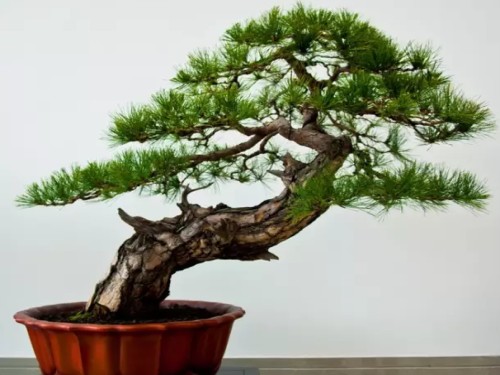
Su-style penjing consists of five major parts: first, the roots; second, the stem; third, the nodes; fourth, the new branches; fifth, the crown. One only needs to process and shape the five major parts separately, and it can become a living work of art.
1. Raising the roots
According to the distribution of the roots, lift the root system above the soil surface and arrange it in all directions. Those that coil and rise vigorously on the surface of the pot are considered superior, and those with buttress roots exposed on the soil surface are also good. They can be upright, slanting, or lying flat. "The head must form layers, the feet must form lines," so as to achieve "hanging roots and exposed claws" and show great age. Root raising must be carried out year by year and step by step; it is not advisable to raise too much at once, in order to prevent damaging the roots and affecting growth. If the roots are thin, they must not be lifted above the soil surface, otherwise after long exposure to wind and rain, sun and cold, they will all wither and die. They can continue to be cultivated to develop the roots, and after they reach a certain thickness, it will not be too late to raise them. If the penjing has no thick roots, they cannot be exposed on the soil surface.
2. Bending
Most trees are mostly upright, and they need to be bent and tied into several curves and fixed in place; this is called "bending." There is a rule for bending, called "straightness within the curves, the crown and roots facing each other." This means that the center of gravity of the plant should not extend beyond the surface of the pot, so as to maintain stability and benefit growth (except for special formats). The bends must not be too prominent or too off-topic. Making the first bend is called the "base bend," also called the "first bend out of the soil." The bend can go to the left, to the right, or backward, but it is not suitable to bend it forward; this is also basic knowledge.
3. Node cutting
Node cutting generally involves two situations. First, after potting and bending, saw off the branches that are useless for the shaping. When sawing branches, leave short stubs according to the needs of the tree's shaping; do not saw them all flat. Second, before potting and shaping, take the trunk that is thin, long, tall, and has no branches and is difficult to shape, and cut it short at a certain distance from the ground, letting it sprout new branches again. Or, if there are several small trunks on the roots, keep only one trunk and cut away the rest, using a side branch to replace the main trunk; in this way, the tenacious vitality of a natural tree can be shown even more. This is also called "node cutting," but the specific methods can differ.
4. Making pads
Take each main branch, side branch, and third-node and fourth-node branch of the trunk, all with leaves, and shape them into tree pads such as "dumpling-head shape" or "cloud-pad shape." The requirement is that the trunk pads be full, slightly higher and somewhat protruding in the middle, round, thin, and flat; this is called "making pads." On the trunk, "front-facing branches" (the side of the branch pad facing the viewer) are not allowed to appear, and pads must not be made on front-facing branches. Pad making is mainly by pruning, with tying as a supplement. If palm rope is used to tie them into flat, thin pads, it takes a great deal of work and time, and ordinary people also lack this skill, so pruning and pinching to gather the pads is the main method. Generally, pads are made on the main branches, one pad per branch, or with a divided pad. The branches coming out from the main branch should emerge from the hump-backed direction of the trunk, and must not emerge from the inner curve. In pruning and pad making, first avoid the "carrying-pole branch," that is, making pads on the left and right to form a straight line with no distinction of length. Second, avoid the "front-facing branch." Among the branches emerging from the trunk, if one branch goes straight forward as if to poke the viewer's eye, it is truly unsightly; it should be sawed flat. Better to have one branch fewer than to keep this eyesore. Pay attention to the branch pads behind the trunk; these are called "back-wall branches," and back-wall branches can make the penjing tree thick and full with a three-dimensional feel.
5. Finishing the crown
The requirement is that the crown and roots face each other, and the crown pad should not exceed the area of the pot bottom (except in special cases). Pay attention to appropriate dynamism, and even more attention must be paid to having an upward-looking effect. The tree crown should lean backward by 1~2 cm; never use a bowing style. The size of the crown should preferably be only two or three tenths of the entire branch pad, and must not be larger than the branch pads. Specifically speaking, it is required to achieve large on top and small below, or left-right symmetry, and it must not be parallel top and bottom, or a single isolated pad that does not echo the others. One branch pad and the other branch pads must be mutually connected, the branch pads must have clear layers, and each pad must be stable and neat, not shading one another or overlapping one another. Pay special attention that the branch pads must not be in even numbers; they should be in odd numbers, so that when viewed as a whole they have dynamism and are not rigid. If they are the branch pads of a cliff-style penjing, they should be wide on top and narrow below, so as to appear especially vigorous, strong, and powerful.