A Detailed Explanation of the Techniques and Skills of Lingnan-Style Penjing
In creating Lingnan penjing, materials are mostly sourced locally, using subtropical and tropical evergreen fine-leaved tree species, generally based on tree stumps that Guangzhou people call “shu zai tou” (little tree heads), with as many as several dozen varieties. Lingnan penjing is one of the outstanding traditional arts of the Han people and a treasure of garden art.
Lingnan people, especially those from Guangzhou, are passionately fond of penjing, and growing penjing has become part of people's daily life. Many households grow and display penjing on their rooftops, balconies, living rooms and studies, using them to beautify the environment and enrich life; they please the eye, delight the mind, and cultivate character. Lingnan penjing mostly uses Shiwan colored pottery pots, including round dishes, square pots, polygonal pots, oval pots, rectangular pots and tall pots, with attention paid to water absorption and breathability, harmonious color, appropriate size, and a simple, elegant look. Display stands come in floor-standing and tabletop types, mostly made of more precious woods such as rosewood, so that everything is coordinated and harmonious, setting each other off to advantage.
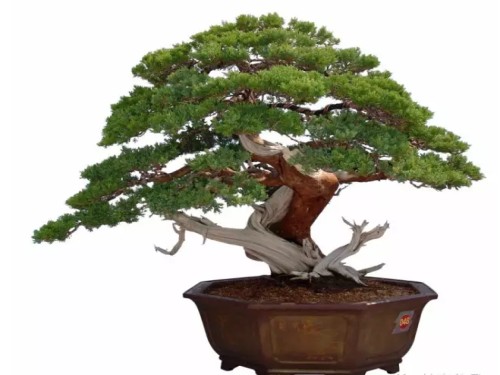
Lingnan-style penjing has three characteristics that distinguish it from other schools:
First, its creative techniques are unique, taking nature as the teacher and emphasizing branch and trunk skills; the shaping or compositional layout comes from nature yet rises above it, striving for an organic combination of natural beauty and artificial beauty. This is why Lingnan penjing is praised as a “living Chinese painting.”
Second, it focuses on the shaping and selection of both the landscape and the pot, striving for harmony and coordination between pot and scenery.
Third, it makes good use of pruning while leaving no trace of the knife or scissors. This technique is the greatest characteristic of Lingnan penjing, so people generally believe that Lingnan penjing is purely cut and shaped with knives and scissors. By pruning branches and cutting leaves, the plant is made to grow and develop according to human will; as time passes, the traces of artificial cutting gradually disappear, and the various forms look as if naturally made, with workmanship that rivals nature.
According to the tree species used and their natural advantages, Lingnan penjing applies appropriate techniques, using artificial craftsmanship to compensate for the defects of the tree stump, so that the work can be as perfect as possible and better highlight the style of the tree species and reflect the creator's intent and character. Specific decorative techniques include: the carving and chiseling method, the skin-lifting method, the skin-beating method, the wooden wedge method, the branch-carrying method, the T-shaped branch grafting method, the direct grafting method, the head-root and aerial-root grafting method, and so on.
1. Carving and chiseling method
This means removing, at the time of reforming the blank, the excess parts of the tree stump that do not meet creative requirements or that affect the creative concept and the work's shaping, such as horizontal supports and horizontal branches, so that they will not affect the beauty and harmony of the whole work. When using the trunk-truncation method to trim the tree blank, the wound left after sawing is chiseled into a slightly arched shape, kept smooth and clean, then coated with wound-healing liquid, covered on the surface with plastic film, and tied firmly with rope.
2. Skin-lifting method
If a part of the trunk is slightly sunken and affects the integrity of the tree body, or if a certain part of the trunk bark is felt to be too smooth and not rugged enough, the skin-lifting method is used for shaping. At the part to be shaped, following the grain of the tree, use a sharp knife to cut open the bark layer and gently lift the bark away from the wood, so that the bark and wood at the shaped part are slightly separated. After it grows for a certain time, the lifted wound gradually heals and a bulge appears, or the bulge causes the bark surface to become uneven, making the trunk prominent and rugged.
3. Skin-beating method
The principle and effect of the skin-beating method are much the same as those of the skin-lifting method. The skin-beating method is suitable for tapping with a mallet made of harder wood.
4. Wooden wedge method
If a certain part of the tree stump being created is sunken too deeply and affects the beauty and harmony of the whole work, the wooden wedge method is needed. First use a straight-edged sharp knife to chisel a crack down to the xylem at the sunken part to be worked, following the direction of the bark layer; then make a wooden wedge from harder wood with the same width as the crack, with its thickness determined by how much the sunken part of the trunk needs to bulge, and gently drive it in along the chiseled crack so that the surface bark layer bulges, but the bark layer must never be forced apart.
5. Other commonly used grafting methods
These include the branch-carrying method, the T-shaped branch grafting method, the direct grafting method, the head-root and aerial-root grafting method, and other methods.