The Style, Layout and Styling Characteristics of Sichuan-Style Bonsai Art
A long history and favourable natural conditions have driven the continuous development of bonsai art, while the splendid Ba-Shu culture and the region's uniquely rich natural materials gave birth to today's distinctive Sichuan-style bonsai art.
A stylistic approach that pursues nature and combines form with spirit:
Sichuan-style bonsai styling comes from life, yet rises above life; it breaks away from the purely imitative mode of copying nature and incorporates more emotional elements and rational control. Materials are drawn from nature and express nature; the trees are rarely pierced with holes or carved and chiselled by force, and although they are shaped repeatedly, they bear no trace of the knife or axe. At the same time, the strict metrical patterns of poetry are used to embody symmetrical beauty, balanced beauty and rhythmic beauty.
A layout that is delicately elegant and majestically beautiful, deep and far-reaching:
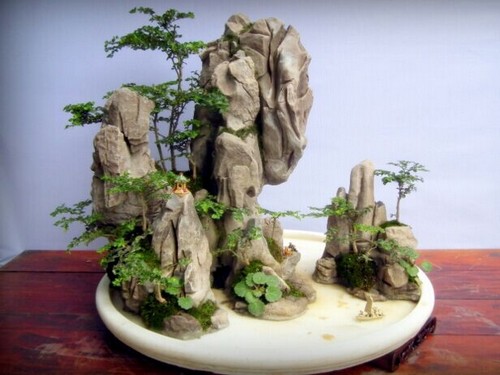
In layout, Sichuan-style bonsai draws on the famous mountains and great rivers of the region and excels at the combined arrangement of trees and stones, bringing together the seclusion of Mount Qingcheng, the elegance of Mount Emei, the peril of the Three Gorges, the grandeur of Jianmen and the wondrousness of Mount Wu into one, ingeniously expressing the mysterious and reclusive character of the local mountain forests. The materials often chosen are tree species with short, much-bent internodes that can express an elegant, flowing quality, such as snow-in-summer (Serissa japonica), Distylium racemosum and Chaenomeles speciosa, combined with stones of varied, many-angled forms. The main mountain towers aloft with a majestic momentum, while the subordinate mountains are arranged closely together in varied shapes, revealing a deep, secluded and wondrous beauty; in particular, many plants are combined with landscape bonsai, giving spiritual mountains and elegant waters, a land of rare treasures. This is clearly different from Su-style bonsai, which chooses stones with a sharply rising dynamic and tree species with rounded or cloud-like foliage pads.
Styling characteristics that are grand and steady, clear and elegant:
The development of Sichuan-style bonsai art has gone through a process in styling from simple to complex, and then from complex back to simple. The first "simple" means plain, the latter "simple" means concise. Like other bonsai schools, Sichuan-style bonsai takes the composition principles of painting as its foundation, but at the same time it selects materials from the natural world, imitating the postures and variations of old trees and continually summarising rules and set forms, which through the refinement and perfection of artists over successive generations have developed into today's eight trunk forms and three branch methods.
Sichuan-style bonsai rejects affectation and stresses centre of gravity and balance, so the plant styling mostly adopts a steady, level form. The branches spread flat and the trunk is arranged with a lean, combining strength within softness, like iron strokes and silver hooks, much like Yan-style running script in calligraphy, appearing very vigorous and dignified. It is the first choice for use as a contrasting feature and main feature in plaza and indoor planting.
Its branches are bent and trained to form oval, broadly oval and fan-shaped foliage pads, mostly arranged to the left and right; to achieve lightness and variation, detailed styling using the changing branch method and variations in the density of branches and foliage are used to reduce the bonsai's sense of drooping and heaviness. Branches are sent out not only to the left and right but also to the front and back, or various bending arrangements of branches are set within the crown space (such as upright curved branches, slanting curved branches and recurved branches), forming a styling character in which grandeur contains elegance and clear beauty contains nobility.
The Podocarpus macrophyllus bonsai in the picture above is styled using the Sichuan-style "dropped turn" trunk form, with branches sent out front, back, left and right, steady yet still flowing. The leaning trunk reduces the bonsai's tendency to droop, and the wind-blown branch method creates a sense of movement. The flatness and steadiness of the crown pad, together with the curved-turn styling and the leaning arrangement, fully embody the characteristics of Sichuan-style bonsai.