What are the historical origins of Sichuan-style bonsai art?
Sichuan has a suitable climate, dense vegetation, abundant resources, and outstanding people; since ancient times it has enjoyed the reputation of the “Land of Abundance,” providing the conditions for bonsai development. Sichuan bonsai is a bonsai art school named after its region; it originated in the Five Dynasties period and has a long history.
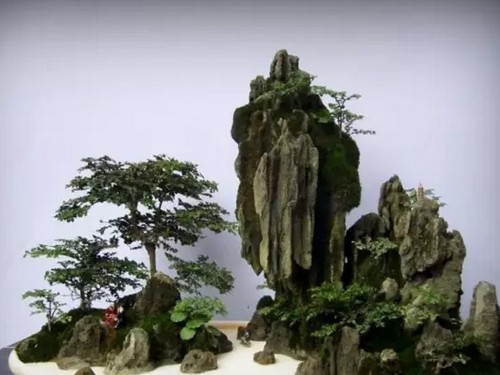
Sichuan bonsai is roughly divided into two artistic styles, western Sichuan and eastern Sichuan, centered respectively on Chengdu and Chongqing, among which the tree-stump bonsai represented by Chengdu best embodies the characteristics of Sichuan bonsai. Chengdu tree-stump bonsai emphasizes freehand expression, is elegant and graceful, and wins acclaim for its rich and varied plant materials; with its unique artistic style, it is recognized by the gardening world as one of the eight major bonsai schools of our country———Sichuan-style bonsai, renowned at home and abroad.
Its long history and superior natural conditions have promoted the continuous development of bonsai art, while the splendid Bashu culture and the locally unique and abundant natural materials have given birth to today's distinctive Sichuan-style bonsai art.
The customs and land of Bashu have accumulated a profound artistic heritage.
"The mountains of Ba and the waters of Shu, with floods and droughts governed by man," as early as the Han Dynasty, Chengdu was already a cultural center and economic stronghold of the southwest. From Chen Zi'ang's lament that "there is no one before him, and no one after him," to Xue Tao's unmatched couplet "Gazing at the river flowing, gazing at the river flowing, gazing at the river flowing from the Wangjiang Tower; the river tower endures through the ages, the river flows through the ages," to the heroic spirit of the Three Su across two generations, and to modern poets Guo Moruo, Ba Jin and others' odes to the scenery of Shu, the brilliance of Shu's outstanding people is evident at a glance.
The Four Elites of the Early Tang, Li Bai, Du Fu, Wang Wei, Jia Dao, Li Shangyin and others once settled in Shu for long periods and created many widely praised works. On the one hand, these works drew their essence from the scenery and culture of Bashu; on the other hand, they incorporated the authors' individual artistic achievements, thereby continuously injecting fresh blood into the developing Bashu culture and forming rich and varied artistic forms.
The "Record of the Great Sage Ci Painting" once recorded the grand occasion of painters gathering in the Chengdu area at that time, saying that "among all Tang painters under heaven, none are as numerous as those in Chengdu." From painters born and raised there, such as Huang Quan and his son, and Shi Ke, to Wu Daozi, Li Sixun, Zuo Quan and others who sojourned in Shu, as well as modern masters Zhang Daqian, Xu Beihong and other art celebrities of successive generations, they not only continuously promoted the development of Bashu culture and art, but also profoundly influenced the stylistic orientation of bonsai art.
If steadiness and grandeur are what Sichuan-style bonsai draws from the demeanor of poets and painters, then elegance and variability come from the inspiration bestowed by religious art. As an important component of historical culture, religious thought played a rather key role in the development of Sichuan-style bonsai. Taoism, as the native religion of our country, achieved unprecedented development from the Northern and Southern Dynasties onward, especially in the southwestern region, where together with Buddhism introduced from Tianzhu it formed the pattern of "beautiful mountains standing in abundance, temples and monasteries frequently seen." To some extent, the prosperity of religion determined the ideological content of artistic creation; Sichuan-style bonsai drew more from the thought of native religion, embodying the elegant and plain demeanor of Taoism.