Sichuan-style bonsai reflects Chengdu's refined and elegant urban character
In Chengdu's gardens and museums, bonsai is a major highlight. As a distinctive intangible cultural heritage of Chengdu, Sichuan-style bonsai is one of the four major schools of traditional Chinese bonsai. Starting from the Eastern Han Dynasty, bonsai artists in the Shu region began exploring how to condense the wonders of mountains, waters and nature into a small pot. By the Five Dynasties, the bonsai art of the Shu region was flourishing and developing a style of its own. Sichuan-style bonsai originated in the Tang and Song dynasties, took shape in the Ming and Qing dynasties, and ultimately formed a unique school and style of Sichuan-style bonsai craftsmanship. Sichuan-style bonsai is renowned worldwide as “high art that beautifies nature,” and further reflects that Chengdu has always been a city of leisure, prosperity, refinement and elegance.
Exploring Intangible Cultural Heritage
Sichuan-style bonsai stands as a unique art, inseparable from the nurturing of the natural and cultural environment of the Bashan-Shushui region
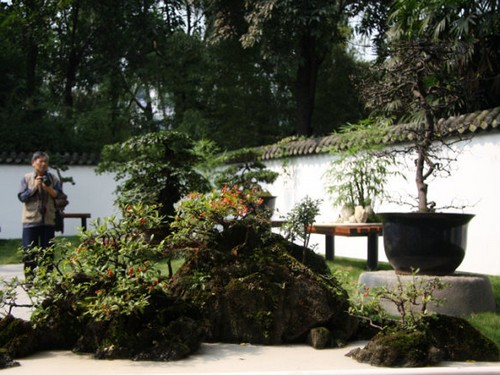
Sichuan-style bonsai has long been praised as “three-dimensional painting” and “silent poetry.” Yesterday, a reporter saw at People's Park that the carefully pruned bonsai were lush and graceful, exquisite and harmonious. They seemed to condense the beautiful scenery of the Bashan-Shushui region within them, making visitors linger with delight. “Sichuan-style bonsai is not only exquisite and beautiful, but also contains profound knowledge.” Yesterday, Zhang Zhongmin, a inheritor of Chengdu bonsai-making craftsmanship, explained the secrets of Sichuan-style bonsai to the reporter in detail. Pointing to the bonsai beside him, he enthusiastically told the reporter that because Sichuan has extremely rich resources of mountains, waters and trees, and its landforms face great mountains and perilous waters, Sichuan-style bonsai combines the shapes of seclusion, elegance, peril, majesty, height, suspension, steepness and depth into the pot. Tree bonsai, meanwhile, condenses the styles of ancientness, cascading, and inverted hanging into a single scene.
He revealed to the reporter that through the exploration and practice of bonsai artists over generations, Sichuan-style bonsai has formed a unique style and techniques in its craftsmanship. The craftsmanship is divided into three types: tree-stump bonsai making, mountain-stone bonsai making, and tree-and-stone combined bonsai making. The first excels at expressing the myriad postures of trees, with superb aesthetic value and ornamental effect; the second excels at expressing fantastic mountains and grotesque rocks and the wondrous creations of nature, giving people a refreshing experience; the third integrates the first two techniques into one, comprehensively expressing the seclusion and peril of trees, mountains and waters, and embodying a harmonious and highly condensed aesthetic. No matter how endlessly varied Sichuan-style bonsai may be in craftsmanship and expressive methods, its core is inseparable from the nurturing and influence of the natural and cultural environment of the Bashan-Shushui region. He said proudly that the most essential artistic characteristic of Sichuan-style bonsai is “seeing the great in the small, shrinking a dragon into an inch.” In the 1960s, after appreciating Sichuan-style bonsai, Marshal Chen Yi gladly wrote an inscription: “High art, beautifying nature.” Though the words are plain, they express a Sichuan native's deep affection for Sichuan-style bonsai.
For Sichuan-style bonsai to take shape: emphasis on artistic conception, careful selection of materials, taking as little as 3 to 5 years or as many as 10-plus years
“Making these bonsai takes as little as 3—5 years, or as many as 10-plus years, or even longer.” Seeing the reporter's surprised expression, Zhang Zhongmin explained that Sichuan-style bonsai is centered on Chengdu and represents the bonsai art style of Sichuan Province. In traditional bonsai-making methods, there are five ways to shape branches and trunks: cutting, bending, coiling and tying, grafting, and carving, along with auxiliary methods such as shaping foliage and roots. In the process of shaping and pruning, emphasis is often placed on observing, going slowly, and cutting, carried out step by step. He said that Sichuan-style tree-stump bonsai is especially known for its rich and varied formalized traditional coiling-and-tying techniques, with numerous categories and certain rules; the trunk and side branches are bent from a young age according to different formats, with attention to three-dimensional spatial composition. Trunk forms include the dropping bend, square bend, paired bend, rolling dragon embracing the pillar, three bends and nine reverse bends, and large bend with hanging branches, among others. Methods of coiling branches include flat branches, rolling branches, and half-flat half-bent, among others. The roots of the trees are mostly shaped as tangled roots and exposed claws. Tree species used include golden bullet tree (Diospyros armata), Chaenomeles speciosa, Podocarpus macrophyllus, Serissa japonica, plum, pomegranate, bamboo, and others. In recent decades, while inheriting traditional forms, Sichuan-style bonsai has innovated a group of naturalistic bonsai with natural postures and distinctive features, complementing the traditional ancient, elegant and bizarre stump scenery and creating a new path for the development of Sichuan-style tree-stump bonsai.
How can one create a good work? He explained that the first is conception: making bonsai is like painting, the idea must precede the brush, and one must consider the artistic conception; the next is material selection: whether stone or tree material, it must integrate with the creative conception; finally, the layout must be reasonable, with clear primary and secondary elements, and a good grasp of sparseness and density. To become a master bonsai maker of a generation, bonsai-making skills are certainly important, but traditional cultural depth is also indispensable. Since 1978, Zhang Zhongmin has been engaged in bonsai art creation, garden scenic spot design, construction, and production management; he studies the planar and vertical spatial composition relationships of landscape architecture and bonsai making, and took bonsai art masters Chen Sifu, bonsai artist He Ziyuan, and Chen Guqing as his teachers, comprehensively and systematically learning from them the coiling-and-tying techniques of Sichuan formalized tree stumps, as well as mountain-and-water bonsai making, garden building, mountain piling and rock stacking, water management, and greening and planting techniques. At the same time, he also studied Chinese landscape painting under famous landscape painters Zhang Youju, Zhu Changdi, and Luo Qixin, while self-studying Chinese flower-and-bird painting and calligraphy, making his bonsai full of the artistic conception of Chinese landscape painting.
Tasting History
Sichuan-style bonsai has a long history, celebrated in the chants of literati and scholars through the ages
The craft of Sichuan-style bonsai has continued from the Eastern Han Dynasty to the present. It is understood that in 1979, an Eastern Han tomb was excavated in Chengdu, yielding a rectangular earthenware pottery basin configured with a wood-carved lotus bonsai, which is the earliest physical evidence related to bonsai in Chengdu. Legend has it that during the Five Dynasties, an official surnamed Mei under Meng Zhixiang of Later Shu lived in seclusion in the western suburbs of Chengdu, planting plum trees everywhere and coiling and tying them according to painting ideas, making plum stumps in various postures; in the Tang Dynasty, Sichuan-style bonsai developed to a certain extent, as can be witnessed in some religious-themed stone carvings and grottoes; by the Song Dynasty, poets such as Su Dongpo, Lu You, and Mei Yaochen appreciated and made some mountain-stone bonsai in courtyards and halls during their time in Shu, and their poems vividly celebrated bonsai. For example, Su Xun wrote "Record of a Wooden Rockery," using the scenery to express his feelings. Later, Su Dongpo also wrote "Poem on Two Stones." The patriotic poet Lu You, during his time in Shu, also wrote many poems celebrating bonsai, and he also made bonsai with his own hands. By the Yuan, Ming, and Qing dynasties, the craft of Sichuan-style bonsai developed by leaps and bounds; most importantly, coiling-and-tying techniques arose and developed among folk flower growers, promoting the prosperity of Sichuan bonsai tree stumps and the rapid advancement of techniques.
In the late Qing Dynasty and early Republic of China period, a flower fair was held every year on the 25th day of the first lunar month at Qingyang Palace in Chengdu, where flower growers and bonsai artists from various places sent their formed tree stumps to the fair for display, sale, and evaluation. The precious jade and gemstone tree-stump bonsai currently stored in the “Chuxiu Palace” and “Yangxin Studio” of the Palace Museum in Beijing have forms basically identical to Chengdu formalized tree stumps. These tree-stump bonsai were all birthday tribute gifts sent to the emperor by Sichuan officials at the time, and the displayed trunk and branch arrangements were uniquely characteristic of the Sichuan school. Industry experts comment that if people did not have food and clothing assured, they would never have the leisure and elegance to fiddle with bonsai; and without deep cultural foundations, Sichuan-style bonsai would not have become one of the four major schools of bonsai nationwide. The development history of Sichuan-style bonsai reflects that Chengdu has always been a prosperous and elegant city.