Fangcun Huadi in the Lingnan Flower Country: The Origin and Development of Bonsai Art
Fangcun Huadi is the birthplace of Lingnan bonsai. Huadi, originally named Huadai, is located by the Bai'etan stretch of the Pearl River in Guangzhou, and has a history of flower cultivation of nearly two thousand years. In the late Qing Dynasty, Kang Youwei once built a villa, the "Kang Residence," within Kang Garden in Huadi, and wrote a large number of poems and essays there, among which were lines praising Huadi such as "After a thousand years, the flowers of Huadai still flourish" and "A hundred temples cultivate flowers, the Huadai residence." During the Ming and Qing dynasties, gardens were scattered throughout Huadi, among which were the Eight Great Famous Gardens of Huadi, mainly producing fresh flowers such as jasmine, Arabian jasmine, peonies, and white orchids, and also making old-tree bonsai for sale at the Huadi flower market. In the late Qing and early Republic of China period, the major gardens and flower farms of Huadi, on the occasion of deity birthdays or traditional festivals, widely practiced "flower displays," setting out rare flowers and exotic plants and old-tree bonsai in the gardens for visitors to admire and evaluate, drawing countless tourists in an unprecedented grand occasion. Fangcun Huadi has the reputation of being the number one flower country of Lingnan, and its bonsai art also continued to innovate and develop.
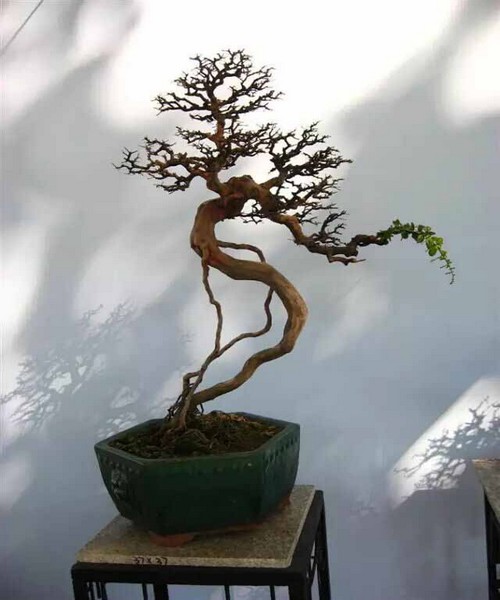
The bonsai of that time mostly had a zigzag ""-shaped form, with the main tree having 5 bends, each bend growing a branch pad, and the treetop being flat-topped. The tree shape was "snail head" or "duck head" and so on. There was also another type of bonsai, in which the trunk was bound with wire into the shapes of the characters for blessing, prosperity, and longevity, or into the shapes of birds and beasts. The old-tree varieties were mainly elm and orange jasmine. This type of old-style bonsai had a unique antique style, but was stereotyped and lacked spirit, and did not accord with the development of the times.
Beginning in the 1920s, new changes appeared in the plastic arts of Huadi bonsai. Some bonsai artists, dissatisfied with the rigid and antiquated forms of old-style bonsai, drew on and absorbed the artistic essence of the Lingnan School of painting, discarded the old and brought forth the new, and through continuous practice and exploration formed an original bonsai art style - Lingnan bonsai art. Huadi is a place with outstanding people and a gathering of garden artists, with Lu Xueming, Kong Taichu, Su Lun, Liang Shen and others as pioneering figures; their bonsai works are diverse and colorful, uniquely Lingnan in style, and presented to the world, deserving to be called masters of Lingnan bonsai art.
Lu Xueming's ancestral home was Nanzhuang in Nanhai County; in the late Qing period his grandfather moved to Rulin New Street in Huadi and opened Cuixiang Garden, cultivating flowers and growing fruit as an occupation. Because his family was poor, Lu Xueming attended a private school for only one year before following his father to work at cultivating flowers in Cuixiang Garden. Carefully taught by his father, he gradually came to love bonsai skills. At that time, a neighbor was an old bonsai artist who specialized in making novel bonsai with a distinctive poetic and picturesque quality and landscape charm. Lu Xueming often went to his home to look, observe, and study, and under his artistic influence and impact attained a certain level of accomplishment in bonsai art. In his artistic exploration, Lu Xueming also studied and absorbed the conception and composition of traditional Chinese landscape, flower, and bird painting, pondering the artistic realm of "within a foot, one can gaze at a distance of ten thousand li; within a square inch, one can discern the steepness of a thousand fathoms," and applied it in the creation of Lingnan bonsai art forms. In cultivation techniques, through constant practice Lu Xueming created skills such as "storing branches and truncating the trunk," "large drifting technique," and "T-character grafting method," making Lingnan bonsai forms more modeled on nature, presenting an artistic realm that has both natural beauty and artistic beauty, originating from nature yet surpassing nature.
Kong Taichu was born in the early years of the Republic of China and was clever from childhood, fond of calligraphy and painting. In his youth, he opened the "Shengmaotai" tea shop in Xiguan, Guangzhou, running a tea business. During the War of Resistance Against Japan he moved to Huadi in Fangcun, and was a neighbor of Lu Xueming. Kong Taichu also loved bonsai art and often went to Cuixiang Garden to admire the bonsai made by Lu Xueming, gradually developing a strong interest in bonsai art. Because they shared the same ideals, they had common ideals and pursuits for bonsai innovation. Kong Taichu opened a plot of land beside his home for planting bonsai, carrying out careful production and cultivation. Kong Taichu advocated realism and reproducing nature, personally copying and drawing pictures of tree stumps in all their forms, pasting them all over his doors and windows, pondering them morning and evening, and capturing inspiration. Kong and Lu learned from each other's strengths to offset their weaknesses and cooperated with each other, constantly innovating in bonsai art. After years of artistic practice, Kong Taichu produced many bonsai art forms, including the weeping willow type, kapok type, banyan type, stone-attached type, cliff-hanging type, lying-trunk type and many other forms, forming a vigorous and forceful unique artistic style and opening a new course for Lingnan bonsai art.
Su Lun's ancestral home was Yagang Gulin Village on the outskirts of Guangzhou; his grandfather moved to Huadi during the Guangxu reign and opened Fulin Garden, cultivating flowers and trees. Su Lun's father was the famous Lingnan School painter Su Wonong. When Su Lun was in his teens, under his father's careful education, he studied painting while also engaging in growing flowers and making bonsai, applying the conception and composition of traditional Chinese landscape, flower, and bird painting to bonsai art. His bonsai artworks are rich in poetic and picturesque quality, like frame after frame of "three-dimensional paintings" and poem after poem of "wordless poetry," opening up the pattern of Lingnan bonsai art and deeply loved by people.
Liang Shen's ancestral home was Chencun in Shunde, Guangdong; at the age of 19 he moved to Huadi, and later went to Cuixiang Garden to learn from a master, engaging in growing flowers and making bonsai. He was diligent and eager to learn, and also hardworking and enduring. In order to select good tree species for various bonsai, he went alone to high mountains across Guangdong to dig up tree stumps, enduring great hardships and fearing no dangers, bringing back tree stumps of all kinds of varieties, and then carrying out careful cultivation and pruning to set their forms. After years of artistic processing, in Cuixiang Garden, bonsai of diverse styles were a dazzling array, with as many as several dozen varieties. There were vigorous and upright elms, orange jasmine, and Buddhist pine, as well as clear and elegant skyflower, mountain orange, crape myrtle and others, wonderfully colorful and dazzling to the eye, the most gorgeous rare flowers in the hundred-flower garden of Lingnan bonsai art.
In the early period after the founding of New China, the city of Guangzhou strongly supported and developed flower and bonsai production. Garden flower farms were scattered throughout Huadi, making it a production base for fresh flowers and bonsai in Guangzhou. In early 1958, Tao Zhu, Secretary of the Guangdong Provincial Party Committee, personally visited Zuiguan Garden and Dongjiao Garden in Huadi, Fangcun, to inspect and understand the situation of flower and bonsai production, and instructed that the flower planting industry should be further developed and the development and innovation of Lingnan bonsai vigorously accelerated. In August 1958, the city of Guangzhou decided to open the Guangzhou Horticultural School at the Luo ancestral hall in Huadi to train flower and horticultural technical talent. During the period of operation, the school invited bonsai artists Lu Xueming, Liang Shen, Su Lun and others to give lectures and teach methods and skills for making bonsai. In the autumn of 1959, He Xiangning, Vice Chairperson of the Standing Committee of the National People's Congress and already over 80 years old, visited Guangdong for inspection and made a special trip to Huadi and Dongjiao to visit and understand the situation of flower production. She praised Lingnan bonsai without end and expressed the hope that this art brand would establish itself in Guangzhou and go to the world. In June 1960, Chairman Zhu De, while on official business in Guangzhou, went by reputation to Zuiguan Garden in Fangcun to visit and enjoy the flowers. Standing in front of a bonsai made by Liang Shen, he praised it repeatedly: "Lingnan bonsai can be called a unique masterpiece." In 1964, Premier Zhou Enlai in Guangzhou selected 4 fine pieces of Lingnan bonsai (respectively masterpieces by Lu Xueming, Kong Taichu, and Liang Shen) as gifts to Ethiopian Emperor Haile Selassie. Later the emperor placed the bonsai in the imperial palace, where they were well received by Ethiopian officials.
During the "Cultural Revolution," flowers and bonsai were regarded as things of the "feudal, capitalist, and revisionist" categories, production was restricted, and each farming household was allowed to grow only 3 bonsai. Many flower farmers were forced to cut down bonsai they had carefully made over many years. Numerous flower farms in Fangcun Huadi were ordered to close and switch to growing vegetables and other crops. The flower industry of Huadi suffered severe damage. In 1983, Fangcun Huadi was invited to participate in the Hong Kong International Flower and Bonsai Exhibition and Trade Fair; the 5 bonsai works submitted by Lu Xueming were deeply loved by Hong Kong citizens and all were subscribed for, among which one elm bonsai sold for 50,000 Hong Kong dollars. In October 1986, Queen Elizabeth II of the United Kingdom visited Guangdong, and Governor Ye Xuanping, on behalf of the people of Guangdong, gave the Queen a precious gift - an orange jasmine Lingnan artistic bonsai. This was a work by Huadi bonsai art master Su Lun, personally made and cultivated for more than 60 years, with a vigorous and forceful trunk yet full of vitality, brilliant in color and rich in fragrance, a perfect artistic fine piece; the orange jasmine was the same age as the British Queen, making it even more specially significant, and it was deeply loved by the British Queen.
In 1989, Lu Xueming was among the first to be awarded the title of "Chinese Bonsai Art Master" by the Ministry of Construction of the People's Republic of China. This was the highest honor given to Lu Xueming; for fifty years as if one day, his persistent artistic pursuit finally reached the summit of bonsai art, and he was fully worthy of the title of art master! This was also the highest evaluation the state gave to Lingnan bonsai art. After the 1980s, a large number of Huadi bonsai artists emerged; they inherited tradition yet dared to innovate and constantly developed. Representative figures of the new generation of bonsai artists include Lu Zhiwei, Lu Zhiquan, Tan Binghuang, Li Yuankai, Li Hongbin, Guo Rupei, Yu Zili, Chen Mingfu, Su Chang, Yu Zhengbiao, Chen Weifu, Liang Weijia, Xie Bingkun and others. Many of these bonsai experts from the Fangcun Huadi area are members of national, provincial, and municipal bonsai associations. Their bonsai artworks are renowned in Hong Kong, China and Southeast Asia.
Lu Zhiwei is the eldest son of Lu Xueming and was once a member of the Guangzhou Municipal and District Chinese People's Political Consultative Conference. From childhood he received his father's teaching by word and example, and he was also good at learning and brave in practice; for more than 30 years he continuously innovated Lingnan bonsai art, exploring several dozen new bonsai forms and new grafting methods, pushing Lingnan bonsai art to a higher artistic realm. Lu Zhiwei also constantly summarized planting experience and wrote a large number of theoretical articles, published in domestic and foreign newspapers and periodicals. His bonsai works won awards many times at national bonsai exhibitions. Among them: at the First International Bonsai Exhibition held in Beijing in 1991, his Fujian tea bonsai "Exploring the Valley" won a gold award; at the Cross-Strait Bonsai Exhibition held in Beijing in 1992, his acacia bonsai "Snow Trunk Reaching the Sky" won a special prize; at the Hong Kong Cup China Bonsai Exhibition held in Guilin in 1997, his Fujian tea bonsai "Green Bridge" won a gold award. In 2004, Lu Zhiwei was awarded the title of "Chinese Bonsai Art Master" by the Urban Construction Department of the Ministry of Housing and Urban-Rural Development. He also served as vice president of the China Bonsai Artists Association. In addition to having a bonsai garden in Fangcun, Lu Zhiwei also founded a bonsai farm production base in Huadu City, mainly producing miniature bonsai, with products exported far to Western Europe and North America.
Fangcun Huadi is therefore praised by people as the "number one flower country of Lingnan" and the "birthplace of Lingnan bonsai." In the early 1960s, Marshal Chen Yi once wrote the moving line "The plants and trees of Fangcun Huadi are fragrant," praising the scene of Huadi's layered green and concentrated fragrance, graceful and colorful plants and hundred flowers blooming together. Today, Huadi advances with the times, making Lingnan bonsai art famous throughout the world and even more dazzling and brilliant.
(The author is a retired teacher of Dongjiao Middle School in Liwan District and a writer of cultural and historical materials for Liwan District.)