How to grow Lingnan ficus bonsai? Detailed care and management tips
Lingnan ficus bonsai can grow for three or four seasons, but during this process it tends to grow fast, become obese easily, and have tender bark color, which leads to a decline in the age quality of many finished works. In our area, affected by the cold climate, the bark grows slowly, giving it the characteristics of mature color, tight bark, and an aged trunk, which in turn makes the finished works more imbued with a sense of vicissitude and beauty.
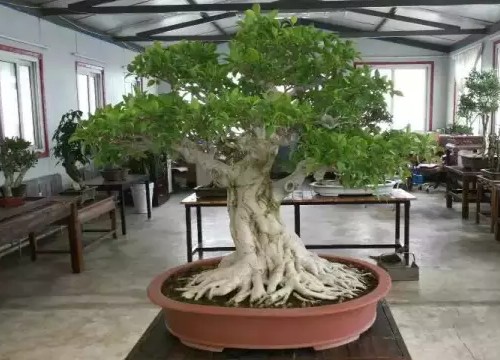
Ficus is an evergreen tree species, with tenacious vitality, a long lifespan, and strong adaptability, but the following points still need attention during care:
Placement: Ficus is an evergreen tree species, fond of light and tolerant of partial shade. During the growing season, it should generally be placed in a ventilated and well-lit spot.
Watering: Ficus is both drought-tolerant and moisture-tolerant. The amount of watering depends on changes in season and whether the weather is cold or warm. In spring and summer, our area is affected by the natural climate, so the indoor environment is also relatively dry; at this time the plant should be replenished with water in a timely manner. In autumn, the water supply should be appropriately reduced according to the plant's specific condition. When winter comes, indoor heating begins in full, and watering should still preferably follow the principle of watering when dry and stopping when wet. If the owner has to go out, the bonsai should be properly shaded before departure to minimize water loss from the plant.
Fertilizing: Ficus likes fertilizer. During the summer and autumn growing period, apply decomposed cake fertilizer once every 15 days, and at the same time also spray potassium dihydrogen phosphate. For home care, compound fertilizer or granular fertilizer can be used, with the method of applying thin fertilizer frequently, grasping the fertilizing season well, and stopping fertilization in winter.
Pruning: Ficus has strong sprouting ability and is tolerant of pruning. As the plant grows continuously, if it is allowed to grow naturally without suppression, it will inevitably affect the tree's shape and cause it to lose its artistic value, so it should be pruned in time, cutting off water sprouts, twin branches, diseased and weak branches, crossing branches, overlapping branches, and so on. Long branches should be shortened, and dense branches should be thinned, so as to maintain a beautiful tree shape and appropriate proportions. In addition, during the peak growing season, the plant should be pinched and buds removed, so that the branch layers above, below, and around the bonsai do not shade one another and can all receive sunlight and be nourished by rain and dew, in order to achieve the best growth of the plant.
Repotting: Ficus grows relatively fast. Small bonsai should be repotted once a year, medium bonsai once every two years, and large bonsai once every three to four years. Ficus likes loose, fertile acidic soil, and its nutrient soil can be made by mixing alluvial sandy soil with thoroughly composted organic fertilizer. During repotting, one-half or two-thirds of the old soil can be removed, and dead roots, weak roots, and damaged roots should be cut off in time, coated with a growth agent, and then planted into the soil. After planting well, water thoroughly once to settle the roots.
Pest control: The main pests of Ficus are aphids and red spiders, which can be sprayed and killed at the same time with Alawan, jiesha, and omethoate. In spring and autumn, thiophanate-methyl should be sprayed to achieve the purpose of sterilization, so that the bonsai can grow better.
Keeping warm: In our area, the outdoor temperature in winter is as low as about minus 26°C, so we need to build a greenhouse to prevent cold and keep warm. On this basis, heating equipment should also be installed. When snowy weather arrives, first, snow should be removed in time, and second, the boiler should be fired for heating, so as to ensure that the minimum room temperature for the trees is not lower than 8°C to 10°C, so that they can overwinter safely.
Maintenance: After the ficus bonsai has taken shape, it begins to enter the ornamental maintenance period. Twice a year, it can shed its leaves and change its brocade to appreciate its skeleton, and during the rest of the time its leaves and tree shape can be appreciated, so it is truly enjoyable in all four seasons. After each pruning and sprouting, pinching can be carried out, which can both keep the tree shape unchanged and make the leaves smaller.