An Analysis of the Technical Characteristics and Artistic Style of Lingnan Penjing
Lingnan penjing is mainly based on tree stumps and originated in the 1930s and 1940s. Lingnan is located in the subtropics, with abundant rainfall and mild weather all year round, suitable for plant growth. Historically, Guangzhou was one of the earlier open treaty ports, with relatively open-minded thinking and a culture that embraced diverse influences. Due to factors such as climate, geography, and human history, Lingnan penjing has developed an artistic style that retains Chinese tradition while also possessing the fresh and lively characteristics of the Lingnan era. Lingnan penjing is consistent with other schools of penjing in its essence and goals, all pursuing poetic imagery and the unity of form and spirit; their artistic techniques all originate from nature yet transcend nature; their shaping and branch techniques all draw on the brushwork and painting principles of Chinese painting. However, in terms of expressive forms and crafting techniques, Lingnan penjing differs significantly from other schools of penjing, thus forming a completely distinct artistic style.
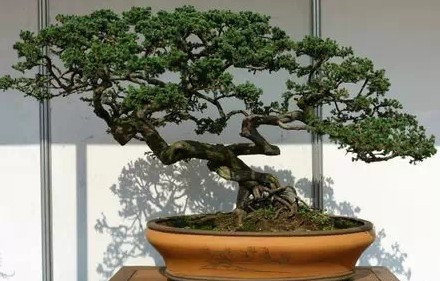
Specifically, the technical characteristics and artistic style of Lingnan penjing are mainly manifested in the following aspects:
1. Close-view tree shaping, with attention to detail
If other schools of penjing focus on distant-view tree shaping, looking at the big picture and expressing an antique, dignified, grand and stately quality, then Lingnan penjing mainly uses close-view tree shaping, paying attention to detail, expressing wild natural charm, with external elegance and inner strength. This close-view tree shaping is mainly reflected in the meticulous carving of branch techniques. Lingnan penjing has a wide variety of branch techniques, including deer-horn branches, chicken-claw branches, crab-claw branches, cascading branches, weeping branches, wind-blown branches, natural branches, turning-back branches, pinwheel branches, spiral branches, and so on. Different branch techniques are used according to different shapes and themes to achieve different effects.
2. Branch cultivation and trunk truncation, as if naturally formed
In terms of crafting techniques, other schools of penjing mainly use binding and wrapping, while Lingnan penjing mainly uses pruning and truncation, that is, branch cultivation and trunk truncation as the primary crafting technique. This is the main factor that forms the unique style of Lingnan penjing. The so-called branch cultivation and trunk truncation means that according to the needs of the tree stock and the shaping, the trunk is cut and trimmed, and the branches are cultivated and shortened, allowing new shoots to sprout from their tips; when they grow to a suitable size, they are cut again, and this is repeated, making the trunk shorter and more supple, and the branches twisted and powerful, strong as bent iron. This unique technique makes Lingnan penjing appear as though made by human hands yet as if opened by heaven, vigorous and forceful, with wild natural charm, reflecting the profound skill of Lingnan penjing.
3. One method, countless forms, with diverse styles
Under the artistic principle of learning from nature yet surpassing nature, Lingnan penjing extensively gathers and adopts wondrous trees and unusual plants from the natural world, ancient trees and new branches, and is not confined to one pattern or bound by convention, with forms in countless varieties. After decades of exploration and accumulation, it has created the single-trunk style, double-trunk style, one-head multi-trunk style, cliff-hanging style, water-reflection style, rock-attached style, lying-pot style, water-and-dry landscape style, and forest style; as well as the straight-tree type, big-tree type, slanting-drift type, ancient banyan type, kapok type, ancient pine type, and so on. This reflects the rich and varied expressive forms of Lingnan penjing, with endless variation.
4. Rigorous composition, with beauty in harmony
The close-view tree shaping of Lingnan penjing not only requires overall beauty and harmony, but also has a rigorous set of rules for every component such as roots, trunk, branches, tips, and leaves. Roots should be extended and powerfully twisted. Different tree types also have different requirements for roots, such as coiled roots for the big-tree type, offset roots for the slanting-drift type, buttress roots for the kapok type, and claw roots for the cliff-hanging and water-reflection types; the trunk should have grain and nodes, with a rugged body and a natural crown; branch supports should be thick and strong, with the four directions clearly distinguished, with proper yielding and contesting, and orderly light and heavy placement; tips should be divided into front and back, with proper rising and bending, dense yet not solid, sparse yet not scattered; leaves are valued for being small and fine, with appropriate density, front not covering back, mutually enhancing each other. The overall veins of the tree are interconnected, with glances that convey feeling. Attention is also paid to the harmonious coordination of tree, pot, and stand.
5. Four-season charm, with vivid dynamic feeling
This is the most expressive and prominent aspect of Lingnan penjing. Through pruning and leaf-plucking techniques, it vividly displays the different scenes of the four seasons. In spring, buds sprout, with dots of new red; in summer, lush and rich, with emerald canopies like clouds; in autumn, golden wind, with yellow leaves drifting down; in winter, cold skies, with bare branches and exposed tips. The charm of the four seasons is pleasing to the eye and evokes emotion in the viewer, stirring the heart. Through the creation of artistic conception, feeling is given to the tree, and the tree is used to express aspiration, so that the scene is within the pot while the spirit overflows beyond it. This reflects the unity of form and spirit in Lingnan penjing, and the unity of formal beauty and inner beauty.