Yangzhou-style penjing debuts on the world stage, with Chinese penjing art master Zhao Qingquan giving a special presentation
With no prominent signboard hung high and no luxurious decoration, Master Zhao Qingquan's studio, tucked away in a corner of the Penjing Museum in the Ten Thousand Flower Garden of Slender West Lake, looks quite simple and understated.
When the reporter walked into Zhao Qingquan's office, he was on the phone with Su Yiji, former chairman of the International Bonsai Association and a famous penjing and viewing stone artist from Taiwan, China, discussing matters related to the 2013 International Penjing Convention and the 50th anniversary celebration of the International Bonsai Association, soon to be held in Yangzhou. Throughout the interview, he was interrupted from time to time by calls from home and abroad.
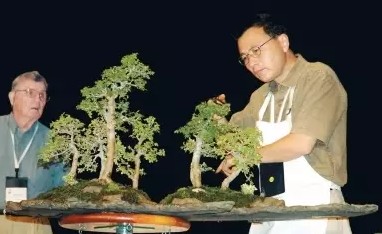
For this grand event held in Yangzhou, Zhao Qingquan used his influence and connections in the international penjing world to do a great deal of work for Yangzhou's successful bid. Over the past thirty years, Zhao Qingquan has traveled around the world, giving over a hundred penjing demonstration performances abroad and showing the elegance of Chinese penjing to the world.
A choice made without regret: giving up the college entrance exam for penjing
My teacher told me that the real skill in making penjing lies beyond poetry. I suddenly understood that no matter how high your craftsmanship, you ultimately become only an artisan; creating with art is the highest realm.
Penjing is one of China's traditional arts, praised as "silent poetry, three-dimensional painting," and Yangzhou penjing has developed almost in step with Chinese penjing. And when people speak of Yangzhou penjing, they are sure to think of Master Zhao Qingquan.
In 1949, Zhao Qingquan was born in Yangzhou. His father was the owner of a private photo studio in Yangzhou, was deeply fond of flowers and penjing, and later founded a flowers and trees shop, which became what was later known as Hongyuan. Influenced by his family environment, Zhao Qingquan loved penjing from childhood. "At that time, enthusiasts often gathered at our home to exchange penjing skills, and I was steeped in it," Zhao Qingquan said.
After graduating from high school, Zhao Qingquan was sent down to the countryside, where he still loved to work with penjing. In 1978, as a person with special expertise, he was recruited back to the city and entered Hongyuan to work in penjing making.
"That I could achieve what I have today is due, apart from my father, to the extremely deep influence of my teacher Xu Xiaobai, a professor at the Agricultural College of Yangzhou University and a penjing expert," Zhao Qingquan said. Xu Xiaobai once served as chairman of the China Penjing Artists Association and was one of the leaders of penjing theory research in our country. "Besides horticulture, he guided me to study many fields, including literature, poetry, painting and aesthetic theory. My teacher told me, 'The real skill in making penjing lies beyond poetry.' I suddenly understood that no matter how high your craftsmanship, you ultimately become only an artisan; creating with art is the highest realm."
With the guidance of a renowned teacher and hands-on practice, Zhao Qingquan grew quickly. At this time, a test concerning his own future arrived: the college entrance exam was restored, and just then Xu Xiaobai received a commission from a publisher; advanced in years, Xu Xiaobai invited his beloved student to co-author the book. "By my grades I should have been able to get into university, but after much deliberation I still decided to give up the college entrance exam." Recalling the past, Zhao Qingquan was full of emotion. What he considered at the time was that if he went to university, he might later have to change careers, and he was unwilling to give up penjing; besides, writing a book was also a process of comprehensive learning. "To this day I have never regretted that choice." This penjing monograph, "Penjing," was printed 4 times, for a total of 240,000 copies, an astronomical figure at the time.
An unforgettable trip abroad: letting Chinese penjing go global
In the international penjing world, Zhao Qingquan has become a banner of Chinese penjing. The voice that "China is the founding country of penjing art" has gradually gained recognition internationally as well.
With the pace of reform and opening up, Chinese penjing art regained its vitality. As a representative of China's penjing community, Zhao Qingquan was the first to step onto the international stage.
"Chinese penjing has a history of at least 1,300 years, yet thirty years ago the international penjing world believed that penjing art originated in Japan." On April 21, 1980, in the prime of his youth, Zhao Qingquan went to Osaka, Japan, to attend the World Bonsai Convention and give a speech. This was his first trip abroad, speaking to the world about Chinese penjing. In Japan, he witnessed the technical level of modern Japanese bonsai and its international influence, and was deeply shaken, which strengthened his idea of "letting Chinese penjing go global."
At that time, Japanese bonsai was already flourishing on the world stage. "After each country's representative finished speaking, they would all say, 'Thank you, Japan, for creating this beautiful bonsai art.'" This scene made Zhao Qingquan very depressed. When it was his turn to speak, he introduced to the guests present that a Tang dynasty tomb mural from China reflected the scene of penjing in the court at that time, which showed that penjing art had a history of at least more than 1,300 years in China. "Whereas Japanese bonsai art with documented evidence spans less than 1,000 years." Zhao Qingquan's speech drew the attendees' attention. During a break in the conference, a professor from the University of Hawaii in the United States sought him out specifically to say, "We truly did not know that penjing had such a long history in China."
Afterward, whenever he had the chance to go abroad, Zhao Qingquan would show the profoundness of Chinese penjing to blue-eyed, blond foreigners: in 1988, within one month he gave 8 lectures in Paris, France, attracting many penjing enthusiasts from Europe; in 1991, jointly invited by 8 American bonsai associations, he gave a 3-month lecture tour in the United States; in 1993, invited to give a live demonstration at the Second World Bonsai Convention, his superb skills won enthusiastic cheers from the audience...
"In terms of technique, the Japanese do very well. When foreign bonsai associations spend money to invite you to demonstrate, they want to see the history and culture behind the penjing you create." Over the decades, Zhao Qingquan has attended the World Bonsai Convention many times and given demonstration performances there, and has also been invited to France, the United States, Canada, Italy, Spain, Australia, New Zealand, Venezuela, India, Malaysia, Indonesia and other countries, giving more than 100 lectures and performances abroad.
These activities expanded the influence of Chinese penjing in the world and also raised Zhao Qingquan's profile in the international penjing world. Some of the penjing works he created in demonstrations have been treasured by the National Bonsai Museum of the United States, the Pacific Bonsai Museum and some famous botanical gardens. He also devoted himself to penjing theory research, publishing more than 100 professional articles at home and abroad and successively publishing more than a dozen monographs. He was not only awarded the title "Chinese Penjing Art Master" by the Ministry of Construction, but also rated an "International Bonsai Master" by the International Bonsai Association, and in 2009 he received the "Award for Promoting Bonsai to the World" presented by the Sixth World Bonsai Convention.
In the international penjing world, Zhao Qingquan has become a banner of Chinese penjing. The voice that "China is the founding country of penjing art" has gradually gained recognition internationally as well.
An unchanging philosophy: innovating on the basis of ethnic culture and local characteristics
He applied the expressive techniques of Yangzhou classical gardens to water-and-land penjing, successfully innovating on traditional water-and-land penjing and creating a penjing artistic conception rich in poetic charm and natural wildness, establishing a style of his own.
In a small shallow marble basin, a grove, a pool of spring water, eight fine horses either drinking by the water or pacing in the woods... This is the scene presented by Zhao Qingquan's famous work "Eight Steeds." This work won first prize at the First China Penjing Exhibition in 1985.
"In penjing art, one cannot merely follow in the footsteps of predecessors; one must develop and open up new territory on the basis of inheriting tradition." Zhao Qingquan traveled to many places in China to study penjing, humbly seeking advice from famous penjing masters everywhere and learning widely from others' strengths, while also deeply studying Yangzhou's traditional penjing culture and its many classical gardens.
Zhao Qingquan gradually established a distinctive personal style: integrating traditional ethnic culture, local characteristics and modern aesthetic taste, combining "poetry, calligraphy, painting and technique" into one. He applied the expressive techniques of Yangzhou classical gardens to water-and-land penjing, successfully innovating on traditional water-and-land penjing, presenting in a basin the natural scenery that combines water surface, dry land, trees and rocks, and creating a penjing artistic conception rich in poetic charm and natural wildness, establishing a style of his own.
Since "Eight Steeds," Zhao Qingquan has been unstoppable, and his works have been selected for relevant exhibitions at home and abroad many times and won awards, including such important awards as the Grand Prize of the World Horticultural Exposition, the First Prize of the China Penjing Appraisal Exhibition and the Gold Award of the China Flower Expo.
"Today's penjing should be a combination of traditional culture and modern concepts, and should be in harmony with the modern civilization of the new era, including its philosophy, aesthetic concepts, science and technology. On the basis of possessing ethnic characteristics, it should further express the author's individuality." Zhao Qingquan explained that today, while preserving traditional techniques, Yangzhou-style penjing has also innovated, and its techniques are constantly being enriched. "People today prefer naturalistic forms and rather dislike works with too many traces of artificial carving. But this does not mean traditional techniques can be abandoned. Only by innovating on the basis of inheriting tradition is breakthrough possible. Innovation divorced from its roots has no vitality and cannot last."
Profile:
Name: Zhao Qingquan
Age: born in 1949
Native place: Yangzhou City, Jiangsu Province
Positions: Chinese Penjing Art Master, senior engineer in landscape architecture, International Bonsai Master of the International Bonsai Association (BCI), international consultant of the World Bonsai Friendship Federation (WBFF); currently working at the Penjing Museum of the Slender West Lake Scenic Area in Yangzhou.
Experience: a student of penjing expert Xu Xiaobai, engaged in penjing creation and research for nearly 40 years, with creation emphasizing the combination of traditional culture and modern aesthetic taste. Combining the expressive techniques of tree penjing and landscape penjing, he successfully innovated on traditional water-and-land penjing, with a style all his own.