How to make a plum-blossom beauty semi-aquatic bonsai? A step-by-step guide
The plum-blossom beauty (Meiren Mei) is a new type of plant produced by crossing a double-petaled pink plum blossom with the red-leaf plum (Prunus cerasifera). It has the characteristics of the plum blossom as well as the traits of the red-leaf plum. Its flowers have multiple layers of petals and are pink in color, and its leaves are fairly dense, mostly red in color. In addition, after the plum-blossom beauty blooms, it produces fruit; the fruit resembles a plum, is a purplish-red round sphere, and can be eaten directly once ripe, with a flavor one would look forward to.
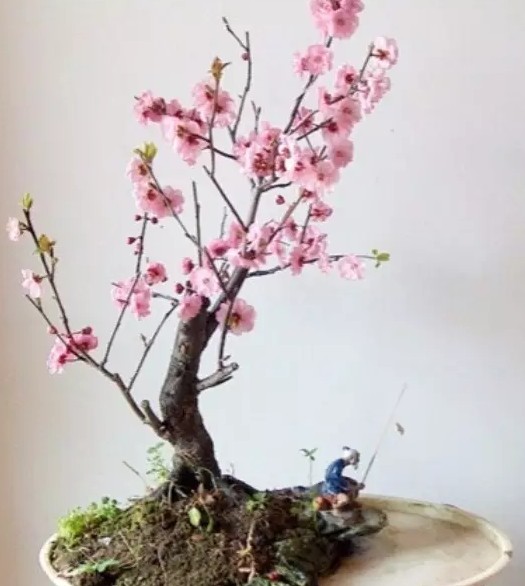
In my spare time I like growing flowers and such to enrich my leisure life. What I introduce below is a semi-aquatic bonsai I made myself last year; it is one of my more satisfying works. Please enjoy it, and feel free to offer suggestions: below are photos taken during the flowering period in the spring of the 12th year.
A brief introduction to the making process: the purple-clay pot chosen is 48 cm long and 38 cm wide; this pot has no drainage holes, so I used simple tools myself to drill drainage holes in the planting area.
Determining the water and land positions is the key to making a semi-aquatic bonsai. I planted the plants on the left and made the right side the water area, with land as the main element, and the shoreline should also be winding and varied. The bottom of the selected rocks must be sawed flat, and the size, height, and front-to-back placement of the stones should be staggered and varied. What I chose is Yingde stone, a commonly used stone for landscape bonsai.
After arranging the positions of the rocks several times and deciding they were basically satisfactory, I then used cement to glue the bottoms of the rocks to the surface of the pot. After the embankment is completed, you can put water in and test it; if water seeps toward the land portion, use cement to plug the leaks.
Next is planting a tree in the land portion, planting a single solitary tree. What I chose is a plum-blossom beauty with flower buds that has been grown in a pot for many years.
Next, let's look at how it turned out when finished!