Detailed Guide to Planting Methods for Landscape Bonsai Plants
When arranging trees on landscape bonsai, the tree species and ecological styling should be chosen according to the desired artistic conception. Commonly used tree species for planting include five-needle pine, small-leaf podocarpus, serissa, boxleaf euonymus, small-leaf elm, Japanese bush cherry, small-leaf privet, and others, while herbaceous plants include asparagus fern, Selaginella uncinata, cattail grass, maidenhair fern, and brake fern. These are all excellent plants for arrangement.
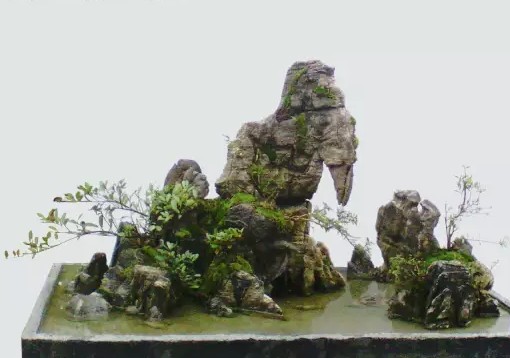
When arranging plants, special attention must be paid to the proportional relationship between plants and rocks. Woody plants are suitable for pairing with larger rocks, while herbaceous plants are suitable for pairing with smaller rocks. According to the Chinese painting principle of: “zhang mountain, chi tree, cun horse, fen person”, the plants should not be too large; the size and height of the planted plants must be consistent with the theme. Plants growing in different locations have different forms due to differences in ecological environment. On flat slopes at the foot of the mountain, clustered trees are suitable, and the trunks are generally relatively straight; trees beside mountain streams mostly lean toward the water; trees growing on cliffs and precipices have a posture of hanging upside down or flying sideways; trees standing on mountain peaks often develop flat-topped crowns.
Therefore, when arranging plants, one must carefully examine the environment and location, and carry out arrangement and styling according to the growth patterns of plants in natural landscapes, and must never act arbitrarily, causing distortion. The styling of woody plants should be cultivated in advance, then planted on the rocks; the root base should not be overly exposed, and there should be both hidden and visible parts. It is advisable to plant trees on the mid-slope of the main peak, on secondary peaks or at the foot of the mountain, or on the side or back of the rocks, allowing the trunk and branches and leaves to extend beyond the stone, so as to increase the sense of layering and further display natural beauty.
Plant arrangement should be properly spaced, with a balance of density and sparseness; trees must not be too densely planted, so as to display the elegance of the mountain peaks. Plant where planting is appropriate, and leave space where space should be left; do not let the secondary overwhelm the primary or become chaotic, destroying the overall beauty of the landscape.
The method of planting plants is generally to first carve out cavities in the rocks, plant the tree roots with soil into the cavities, and cover the surface with moss so that no artificial traces remain. Some can be planted directly into large crevices in the rocks. It looks just like naturally growing trees, presenting a magnificent sight.