Shaping and Care Techniques for Deadwood (Sharimiki) Bonsai Trees
Old trees in nature, battered by lightning, wind, frost, snow, rain, falling rocks and disease, have parts of their bodies withered, their bark peeled away, and their xylem turned into white bone. This naturally formed condition in the wild, where the bark peels off the trunk or the tips of branches, is called a natural “kami”; while the whitening of the xylem on part of the trunk is called “shari.”
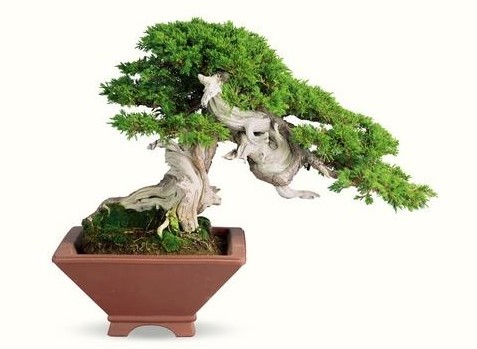
“Shari” is most commonly seen in juniper (crape myrtle) bonsai, and it is also a style that has become popular in recent years. Shari is a Buddhist term, referring to the crystalline remains left after the cremation of Shakyamuni Buddha and other great eminent monks, commonly known as shari beads, displaying the eternal radiance of immortal life. That is, the trunk retains only a few “water lines” (that is, the sieve tubes in the cortex that transport nutrients from top to bottom to the branches and leaves) spiraling upward.
This bonsai shaping technique is relatively popular in Taiwan, China and Japan, and it makes use of the few trees in nature that, having weathered the storms, endured lightning, howling winds, animal bites and insect attacks and other disasters, still struggle tenaciously and survive with difficulty.
It expresses an ecology of sharing life and death, of withering and flourishing mutually supporting each other, and it also leaves a deep impression on people. Making appropriate carvings guided by the circumstances, turning an originally damaged tree stump into a work of artistic effect, is worthy of affirmation and appreciation.
Take “Shimpaku” (Chinese juniper) for example: shari and dead trunks symbolize eternal life. It imitates the distinctive white bone-like dead trunks of junipers in nature, expressing the interdependence of life and death and the struggle against nature, echoing each other until they merge. This tree has relatively large twists and changes, and its shape gives people a shock that reaches from the visual to the spiritual.
It is not hard to see that shari deadwood has its advantages for bonsai shaping. Of course, in China people came into contact with shari deadwood rather late, so it is hard to avoid phenomena such as one-sided understanding, insufficient design, or mishandling that causes deadwood to run rampant, turning an originally very robust bonsai into a withered state full of artificiality, which cannot help but leave people dumbfounded.